
The erythropoietin receptor (EPOR) is a key regulator of red blood cell production, activated by erythropoietin (EPO) to promote survival, proliferation, and differentiation of erythroid progenitors via JAK2/STAT5 and other pathways. It is a validated target for treating anemia, particularly in chronic kidney disease and chemotherapy. Beyond hematopoiesis, EPOR is expressed in non-hematopoietic tissues, suggesting potential roles in neuroprotection and tissue repair. Pharmacological strategies include EPO analogs, non-erythropoietic derivatives, and emerging antagonists. However, safety concerns and resistance mechanisms remain important considerations in therapeutic applications.
EPOR (murine and human)
BaF3
Transfected
BaF3 cells were transduced with a human or murine Erythropoetin receptor (EpoR). Stimulation of these cells with human Erythropoetin in both cases results in IL-3 independent growth of BaF3 cells in contrast to the wildtype cells. This corresponds to literature as published by Pless et al; Blood (1997) 89 (9): 3175–3185.
Viability measured by Cell Titer GloTM
Freiburg, Germany
More information can be found on our website BaF3 Cell Proliferation Assay
BaF3 Proliferation with BaF3 expressing (murine and human) EpoR stimulated with IL3 or Epo
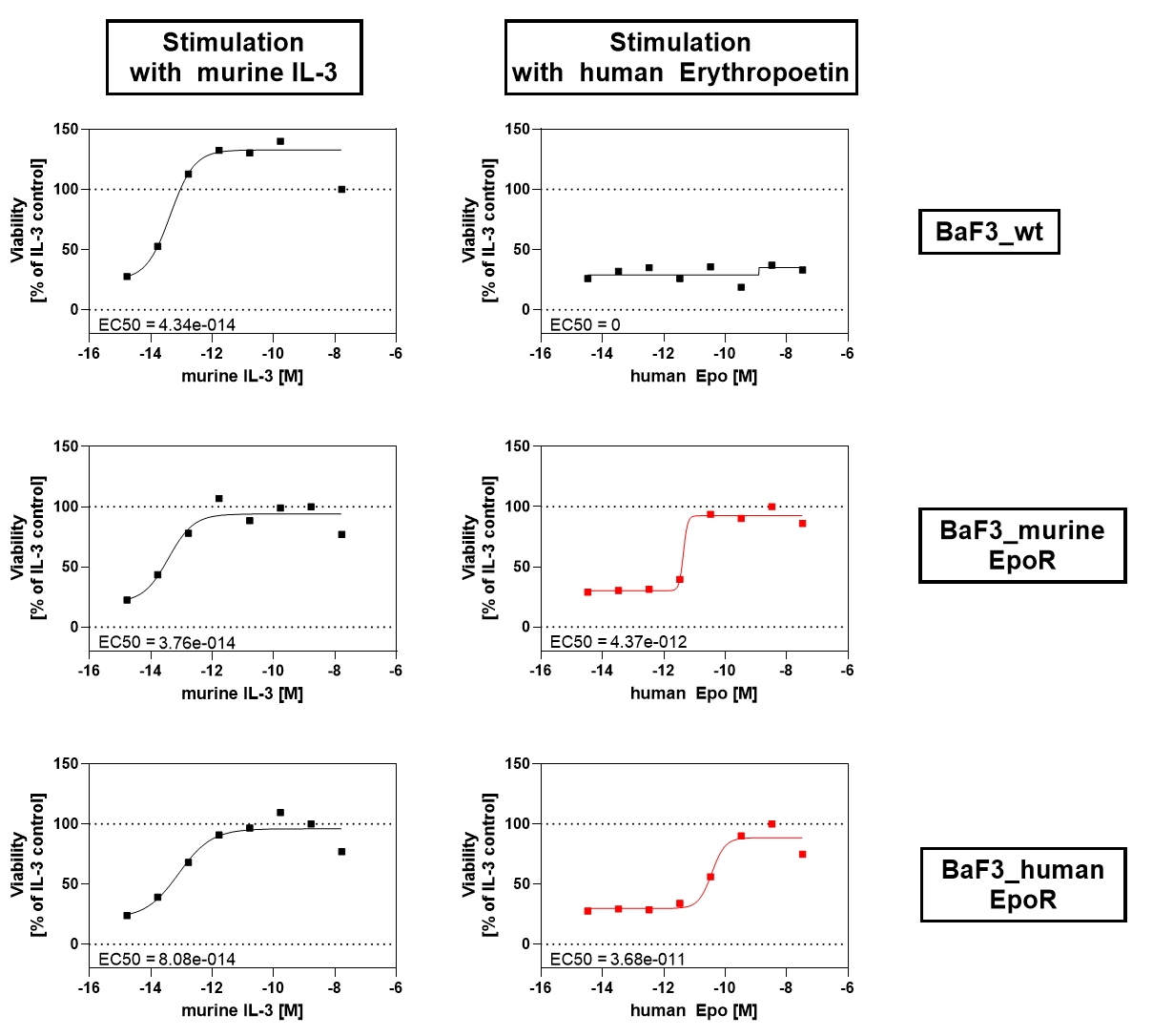
The presence and functionality of human and murine EPOR was tested by culturing receptor-expressing BaF3 cells for 2 days in a.) the presence of increasing concentrations of mIL-3 (left plots) or b.) in the absence of mIL3 and in the presence of increasing human Erythropoetin concentrations (right plots). Cells were viable in the absence of mIL3 and in the presence of huEPO (red DRC), while wildtype BaF3 were not.