
BCR-ABL Cellular Phosphorylation Assay (intracellular kinase activity assay) for compound screening and profiling in intact cells
BCR-ABL is the result of a genetic translocation of the ABL1 gene to the BCR gene leading to the so called Philadelphia chromosome. The resulting fusion protein represents a constitutively active version of the cytoplasmic tyrosine kinase ABL1 which is associated with leukemic diseases such as acute lymphoblastic leukemia (ALL) and chronic myeloid leukemia (CML).
BCR-ABL1
ABL, JTK7, p150, c-ABL, v-abl
K562
Endogenous
In the human CML cell line K562, ABL1 is constitutively active due to the BCR-ABL fusion. BCR-ABL activity is potently inhibited in the presence of cognate BCR-ABL inhibitors such as Dasatinib (BMS-354825) and Imatinib (STI571/Gleevec) (see Fig. 1). Phospho-BCR-ABL levels are quantified by Sandwich-ELISA technique.
Substrate phosphorylation as a readout of intracellular kinase activity via ELISA
Freiburg, Germany
More information can be found on our website Cellular Phosphorylation Assay Services.
Primary reference compound IC50 for BCR-ABL

Dasatinib (BMS-354825) is a well known inhibitor of BCR-ABL which inhibits the autophosphorylation signal of BCR-ABL in K562 cells with highly reproducible IC50 values. The graph shows representative results.
Additional validation data
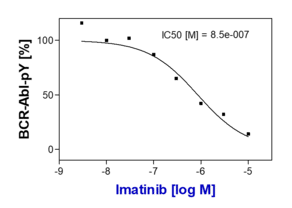
Imatinib (STI571/Gleevec) is a well known inhibitor of BCR-ABL which inhibits the autophosphorylation signal of BCR-ABL in K562 cells with highly reproducible IC50 values. The graph shows representative results.