Kinase Panel Screening
Fast, quantitative profiling to immediately validate the activity and selectivity of newly designed compounds.
Read our latest blog: LinkLight™ Protein-Protein Interaction AssaysLearn More

The experimental biology partner for AI-native drug discovery teams, from validated panels to custom assay development.
Kinase and selectivity panels across 870+ targets, intracellular target engagement, biophysical confirmation, off-target safety, and in vivo pharmacology, with protein production and assay development where no method exists.
Generative design and structure-based modeling produce candidate molecules and target hypotheses faster than any lab can test them. A computational score ranks a compound. It does not measure one. A predicted binder becomes a confirmed one only when its activity is demonstrated against purified protein, inside a cell, and in a living system, under conditions that are defined and reproducible. Wet lab validation is the step from in silico prediction to experimental evidence a program can advance on.
Reaction Biology serves as an extension of your machine learning, computational biology, and medicinal chemistry teams. We offer vast experimental breadth across diverse therapeutic areas including oncology, immunology, CNS, metabolic diseases, and more. Our experience spans target classes from kinases and epigenetic enzymes to ion channels and GPCRs. Whether you are validating traditional small molecules, degraders (PROTACs/molecular glues), or novel biological modalities, our approach is defined by direct, scientist-to-scientist access.
We partner with your team from day one to custom-scope your validation path, optimize assay conditions for novel chemotypes, and interpret complex biological results into actionable next steps. This collaborative feedback loop ensures your computational models are refined by high-fidelity experimental data, helping you advance your program with absolute certainty.
Fast, quantitative profiling to immediately validate the activity and selectivity of newly designed compounds.
Advancing confirmed hits into cellular models and in vivo systems to build a comprehensive data package.
De-risking non-oncology programs and preparing frontrunner molecules for formal candidate selection.
Building customized, reliable screening infrastructure for novel or hard-to-prosecute targets.
ATP concentration is stated per kinase target and adjustable to Km, 1 µM, 10 µM, or physiological 1 mM. Exact construct variants, substrates, buffers, incubation times, and detection methods are fully transparent and delivered with your data. This complete environmental context creates highly reproducible, ML-ready datasets that ensure your generative models train on unambiguous structure-activity relationships (SAR).
Reference control compounds are run on every plate and tracked over the life of a program to prevent batch-to-batch dataset drift. A novel chemotype tested in month one remains directly comparable to an optimized derivative tested in month eighteen. This longitudinal calibration provides the rigorous internal data consistency required to train predictive models without artificial normalization.
Radiometric detection measures 33P-phosphate transferred to substrate—the catalytic event itself—not binding proxies or indirect ADP/FRET readouts. True inhibition is isolated from non-functional binding, filtering out chemical artifacts and optical interference. Your computational pipelines eliminate false-positive loops, ensuring design cycles prioritize actual functional activity.
A single biochemical screening method can miss unique binding kinetics or produce structural false positives. We combine our core biochemical platforms with a comprehensive suite of orthogonal biophysical technologies, including Surface Plasmon Resonance (SPR), Microscale Thermophoresis (MST), and Isothermal Titration Calorimetry (ITC). This multi-parametric approach cross-validates hitting mechanisms in parallel, giving your computational structural models absolute confirmation of real-world molecular behavior.
Biochemical screening, orthogonal biophysics, intracellular engagement, and translationally relevant in vivo pharmacology run under one organization. Your compound handling, controls, and baseline parameters carry uniformly across the entire testing cascade. Data fragmentation is eliminated, preventing the operational friction and model misalignment of moving candidates between multiple niche vendors.
Scoping, customized protocol design, and biological data interpretation happen directly with the Study Director running your work at the bench. Backed by a 24-hour response commitment, we quickly adapt assay parameters when early data uncovers unexpected chemotype properties or solubility limits. Your iterative design-make-test-analyze cycles advance rapidly without administrative or contractual bottlenecks.
Is it active?
Is it clean?
Does it get in?
Does it work?
Does it work in vivo?
Will it fail later?
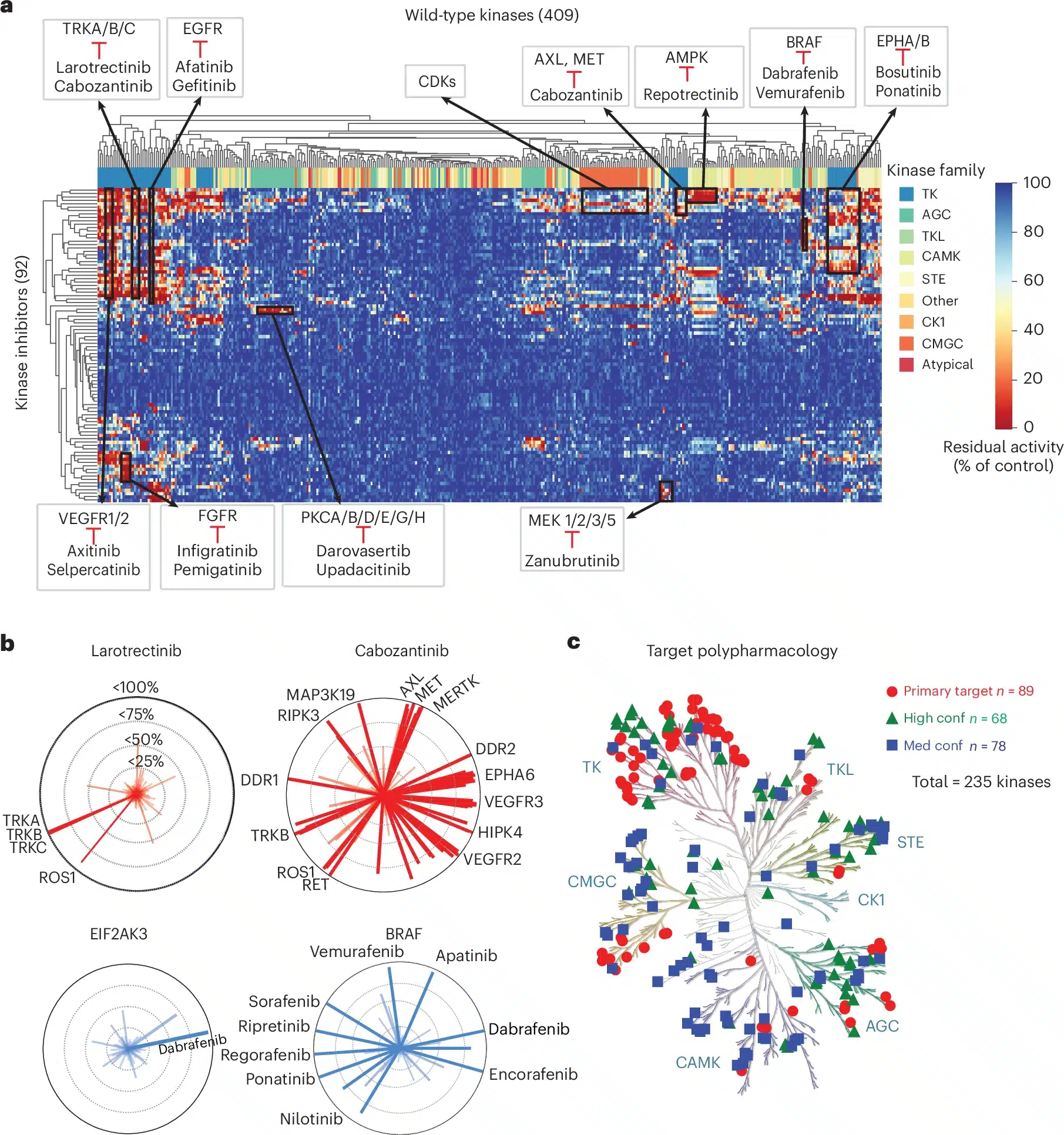
Kinases are the most prolific target class in oncology, and more than 500 human protein kinases share a conserved ATP-binding site, so a compound optimized against one target frequently inhibits others. Off-target kinase inhibition is a leading driver of toxicity and attrition in cancer programs. Selectivity is the defining property of a kinase inhibitor, and it can only be measured empirically. Reaction Biology screens 870+ targets by direct radiometric detection.
870+ targets across US and German facilities, including 260+ clinically relevant mutants, 32 oncogenic fusions, and lipid kinases. Single-concentration profiling with dose-response IC50 follow-up on confirmed actives. Predefined panels and free-choice selections.
HotSpot and 33PanQinase measure 33P-phosphate transfer directly. ATP is stated per target and available at 1 µM, 10 µM, apparent Km, or physiological 1 mM for 340 wild-type kinases. Reference inhibitor control included in every IC50 format.
Wild-type and clinically relevant mutants profiled side by side. Specialty profilers for EGFR, RET, c-MET, ALK, c-KIT, FGFR, BRAF, ABL1, TRK, FLT3, and others resolve resistance mechanisms and support mutant-selective programs.
KinaseFinder identifies kinase targets for compounds of unknown mechanism. Kinase SubstrateFinder identifies substrates for orphan and poorly characterized kinases.
A confirmed biochemical hit is a starting point, not a validated compound. An oncology candidate must reach its target inside a tumor cell, engage it at a relevant concentration, and produce the predicted effect in a living system. This package escalates biological complexity in defined steps, from purified protein through cellular engagement to a first in vivo tumor readout, so failures can be attributed and designed against rather than left ambiguous.
Dose-response characterization against purified target, with ATP-competitive, substrate-competitive, allosteric, covalent, and time-dependent inhibition resolved, plus residence time. Required characterization for the non-ATP-competitive chemotypes computational design increasingly produces.
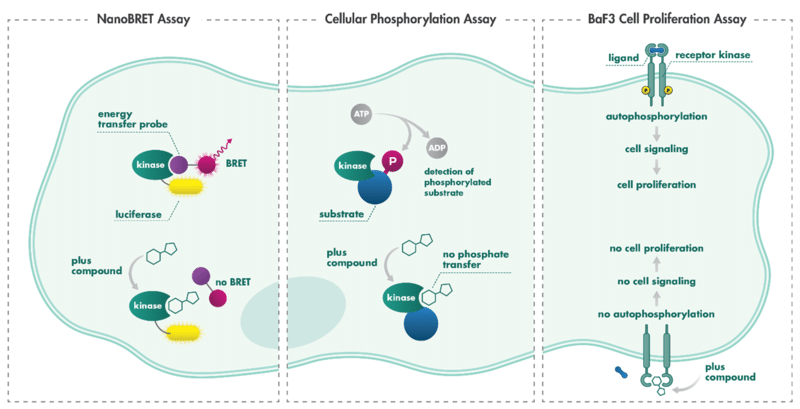
NanoBRET TE intracellular kinase assay measures compound occupancy inside intact cells via BRET between a NanoLuc-tagged target and a cell-permeable tracer. Kinome-wide and mutant formats. Distinguishes activity in buffer from activity in a cell.
Cellular Phosphorylation Assay for downstream pathway modulation and BaF3 Cell Proliferation Assay for target-dependent consequence. ProLiFiler cancer cell panel screening across 160 lines and 3D ProLiFiler spheroid formats extend to phenotype.
SPR for association and dissociation kinetics by refractive index detection, ITC for binding thermodynamics and stoichiometry in solution, MST for affinity at low sample requirement, and thermal shift for higher-throughput triage. Orthogonal to functional data, not a substitute for it.
In Vivo Hollow Fiber Model implants tumor cells in semipermeable fibers at intraperitoneal and subcutaneous sites, doses systemically, and reads viability. Multiple cell lines per animal, at lower compound, animal, and timeline cost than a subcutaneous efficacy study.
Subcutaneous, orthotopic, and metastasis xenograft models, SubQperior tumor models, In Vivo Kinase Activity, and PK/PD. Syngeneic and humanized models and immuno-oncology assays for immune-directed mechanisms.
Every small molecule program, in oncology or beyond, carries the same two risks: activity where it is not intended, and liability the primary assay never sees. Kinase inhibitors, epigenetic modulators, ion channel and GPCR ligands, and metabolic enzyme inhibitors all require selectivity profiled across classes, not just within the target family. For programs in inflammation, immunology, metabolic disease, and CNS, off-target and immune profiling is where a candidate is de-risked before medicinal chemistry investment compounds.
Reaction Biology profiles selectivity across kinase, epigenetic, phosphatase, protease, phosphodiesterase, nuclear receptor, ion channel, GPCR, and metabolic enzyme classes, defines cardiac and off-target safety liabilities through InVEST and cardiac panels, and extends into immunophenotyping and multiplex immune readouts for inflammatory, autoimmune, and neuroinflammatory mechanisms. A model trained on on-target activity has visibility into none of it.
Methyltransferase, demethylase, HAT, HDAC and sirtuin, and reader domain assays. Phosphatase, protease, phosphodiesterase, and kinesin ATPase. Nuclear receptor, ion channel, and GPCR. IDH, carboxylase, NQO, nucleotide metabolism, and PARP.
Broad wild-type and mutant kinome profiling in biochemical format, with kinome-wide intracellular engagement panels where selectivity must be confirmed inside cells.
InVEST off-target panels at 18, 44, 59, and 77 targets, InVEST CYP14 cytochrome P450 panel, and InVEST PDE17 phosphodiesterase panel. Ten business day turnaround on standard configurations.
hERG binding and CiPA-aligned ion channel evaluation, including manual patch clamp electrophysiology.
Multiparameter flow cytometry for immune population and activation state, including microglia and immune marker configurations for neuroinflammation. Multiplex immune assays for cytokine and chemokine output. Immunohistochemistry and TMA for tissue-level phenotyping.
T cell and NK cell killing assays and macrophage assays where the mechanism is immune-directed.
Computational platforms routinely nominate targets with no commercial assay, across every target class and therapeutic area, from kinases and epigenetic enzymes to GPCRs, ion channels, transporters, and protein-protein interactions. A program cannot reach screening until the method exists. Reaction Biology scopes novel and unconventional targets with a study director before a statement of work, then produces the protein and builds a validated, transferable assay that feeds directly into panel screening or a full cascade.
Target assessment with a study director covering known biology, likely construct boundaries, detection format, available reference chemistry, and defined failure modes, ahead of contracting.
Construct design, expression system selection, purification, and activity validation. Specified on activity, stability under assay conditions, and batch consistency across a program, not purity alone.
Functional assay design across radiometric, fluorescence, luminescence, and absorbance detection, selected by reaction chemistry and compound-class interference risk. Optimization of enzyme, substrate, cofactor, buffer, linearity, and signal window, validated to screening-ready Z-prime.
Protein to small molecule, degrader, peptide, protein, oligonucleotide, and antibody. Molecular glue and degrader programs use architecture that reports ternary complex formation, not binary binding.
Engineered cell systems where a cellular readout is required and no suitable line exists.
Wet lab validation is the experimental testing of computationally designed compounds and computationally nominated targets against real biology. A model ranks a molecule; it does not measure one. Wet lab validation confirms whether a predicted binder is actually active, selective, cell-permeable, and free of disqualifying liability, using assays run under defined, reproducible conditions. It is the step that converts an in silico prediction into evidence a program can advance on.
AI-generated candidates need experimental validation because a computational score reflects a model’s training data, not a physical measurement of the molecule. Generative and structure-based models produce far more candidates than any predicted score can qualify, and a large fraction of high-scoring structures show no activity when tested. Biochemical, cellular, and in vivo assays separate the real chemotypes from the artifacts and feed measured results back into the model.
Design-Make-Test-Learn is the closed loop in which an AI model designs molecules, they are synthesized, tested experimentally, and the results are learned back into the model. A wet lab CRO runs the Test step, and the quality of that step determines the value of the Learn step. If the assay conditions behind a data point are undisclosed or inconsistent, the model learns noise. Reaction Biology runs the Test step with stated, constant conditions so each cycle returns data the model can actually use.
Yes. The predictive power of a model is limited by the consistency of the data it is trained on, not only its volume. An IC50 depends on the protein construct, ATP concentration, substrate, and detection method used to measure it, so data pooled from undisclosed or mixed conditions carries variance into the model that more data does not correct. Consistent, disclosed conditions across a program are what make a dataset internally comparable and suitable for training.
The fastest test is single-concentration biochemical panel screening against purified protein. It removes cellular variables such as permeability and metabolism, requires modest compound quantities, and returns an activity fingerprint across many targets at once. Confirmed actives then proceed to dose-response for IC50 values. For kinase programs this is the standard first filter between a set of designs and a decision on which chemotypes to pursue.
An AI-designed small molecule is validated in escalating steps: biochemical activity against purified protein, selectivity profiling across a target family, intracellular target engagement, cellular function, then in vivo confirmation, followed by off-target and safety panels. The order matters because each step adds one biological variable, so a failure can be assigned to a cause rather than left ambiguous. Skipping from a biochemical IC50 straight to an in vivo study produces failures that cannot be designed against.
IC50 values disagree because an IC50 is a property of an assay, not a constant of a molecule. Its value shifts with protein construct, ATP concentration, substrate, detection chemistry, and cellular background. Most kinase inhibitors compete with ATP, so the same compound appears more potent at low ATP than at physiological 1 mM. Reaction Biology states the ATP concentration for every kinase target and holds conditions constant across a program so values stay comparable.
NanoBRET target engagement measures whether a compound occupies its target inside intact living cells. A NanoLuc-tagged target and a cell-permeable tracer generate a bioluminescence resonance energy transfer signal, and a binding compound displaces the tracer and reduces it. Run it after biochemical confirmation and before cellular efficacy or in vivo work, because it identifies compounds that are potent against purified protein but never reach the target in a cell.
Non-oncology compounds are validated with the same escalating cascade plus target-class and pathway assays specific to the indication. Selectivity is profiled across epigenetic, phosphatase, protease, phosphodiesterase, nuclear receptor, ion channel, GPCR, and metabolic enzyme classes rather than the kinome alone. For inflammatory, autoimmune, and neuroinflammatory programs, immunophenotyping by flow cytometry and multiplex immune assays extend validation into functional immune consequence, and off-target and cardiac safety panels define liability early.
Yes. Custom assay development begins with a feasibility discussion covering known target biology, likely construct boundaries, detection chemistry, and available reference compounds, then proceeds through protein expression and purification, assay optimization, and validation to screening-ready criteria. This applies across target classes, including kinases, epigenetic enzymes, GPCRs, ion channels, and protein-protein interactions. It is the standard answer when a computational platform nominates a target no existing assay covers.
Turnaround depends on the assay, but standard kinase panels and single-target work at Reaction Biology are reported in 10 to 15 business days, and InVEST safety panels in 10 business days. Custom assay development timelines are set during scoping and depend on protein production and optimization. Directly accessible study directors and protocol adjustment without a new statement of work keep iteration inside the design cycle rather than adding weeks between rounds.
Reaction Biology does not operate a computational drug discovery platform, does not sell predictive models or curated training datasets, and does not require clients to contribute data to a shared resource as a condition of service. Results are generated for the client program only. Most assay work proceeds from compound identifiers without structural disclosure, and studies can be scoped to a single US or EU site where compound or data jurisdiction requires it.
| Entry point | Service | Format | Coverage | Site |
|---|---|---|---|---|
| Kinase Panels | Kinase Panel Screening | Biochemical, radiometric | 870+ targets | US, DE |
| Kinase Panels | Single-Target Activity and IC50 | Biochemical, radiometric | WT and mutants | US, DE |
| Kinase Panels | KinaseFinder | Target ID | Unknown-mechanism | DE |
| Kinase Panels | Kinase SubstrateFinder | Substrate ID | Orphan kinases | DE |
| Screening Cascade | NanoBRET TE Intracellular Kinase Assay | Cellular engagement | Kinome-wide, mutant | US |
| Screening Cascade | Cellular Phosphorylation Assay | Cellular pathway | Target-dependent | US |
| Screening Cascade | BaF3 Cell Proliferation Assay | Cellular function | Target-dependent | US |
| Screening Cascade | SPR | Biophysical, kinetics | Label-free | US |
| Screening Cascade | ITC | Biophysical, thermodynamics | In solution | US |
| Screening Cascade | MST | Biophysical, affinity | Low sample | US |
| Screening Cascade | Thermal Shift Assay | Biophysical, stability | Triage throughput | US |
| Screening Cascade | ProLiFiler Cancer Cell Panel | Phenotypic | 160 cell lines | US |
| Screening Cascade | In Vivo Hollow Fiber Model | In vivo, short | Multiple lines per animal | US |
| Screening Cascade | Xenograft Models | In vivo efficacy | SC, orthotopic, metastasis | US, DE |
| Selectivity and Safety | Epigenetic, Phosphatase, Protease, PDE | Biochemical | Multiple classes | US, DE |
| Selectivity and Safety | Nuclear Receptor, Ion Channel, GPCR | Biochemical, cellular | Multiple targets | US |
| Selectivity and Safety | InVEST Safety Panels | Off-target | 18, 44, 59, 77 targets | US |
| Selectivity and Safety | InVEST CYP14 / PDE17 | ADME, Off-target | 14 / 17 assays | US |
| Selectivity and Safety | Cardiac Safety Assessment | hERG, CiPA, patch clamp | Ion channel liability | US |
| Selectivity and Safety | Immunophenotyping by Flow Cytometry | Multiparameter flow | Population, activation | US, DE |
| Selectivity and Safety | Multiplex Immune Assays | Cytokine, chemokine | Multiplexed | US |
| Assay Development | Protein Production | Development for expression, purification | Construct to validated protein | US, DE |
| Assay Development | Custom Biochemical Assay Development | Development for multiple detection | Novel targets | US, DE |
| Assay Development | Interaction Assay Development | Development for binding, ternary | Multiple modalities | US, DE |
Radiometric profiling across 870+ targets with stated, adjustable ATP conditions.
The lowest-barrier route to a first in vivo readout, at reduced compound and timeline cost.
Measure compound occupancy of your target kinase inside intact living cells.
Build novel targets, mutants, and custom assays with internal protein production.