1. Engineer the line
- Stable BaF3 line expressing the driver kinase
- Grown in multi-well plates without IL-3
- Survival depends on the transforming kinase

Functional confirmation of kinase inhibition in engineered, kinase-dependent BaF3 cells.
IC50 by proliferation readout across oncogenic drivers and resistance mutants, including activation-dependent cytokine-receptor models, with custom lines built to order.
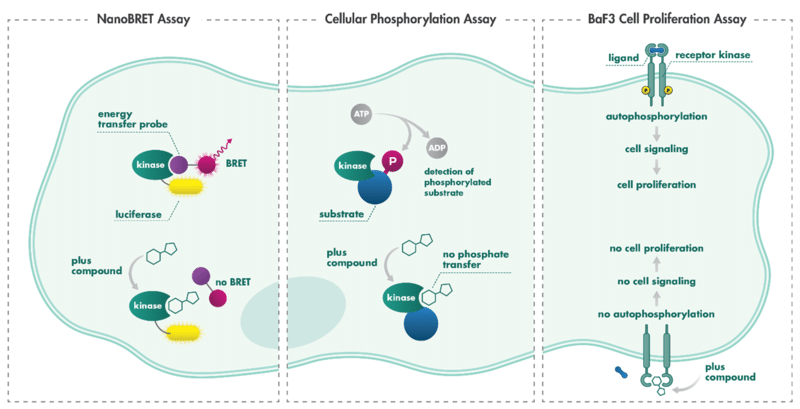
BaF3 is a murine pro-B cell line that depends on interleukin-3 for survival. Stable expression of a transforming kinase switches the cells from IL-3 dependence to kinase dependence: proliferation is now driven by the oncogenic kinase. Inhibiting that kinase removes the survival signal and the cells undergo apoptosis. The readout is functional, confirming that target inhibition translates into loss of cell survival rather than binding alone. A separate parallel IL-3 rescue separates true on-target inhibition from non-specific cytotoxicity, which makes the BaF3 cell proliferation assay a rigorous functional endpoint in kinase drug discovery.
Receptors whose overexpression confers constitutive kinase activity drive IL-3-independent growth on their own. Example: EGFR variants. These lines report inhibitor potency directly through loss of proliferation.
Some receptors do not transform by overexpression alone and require concurrent ligand co-stimulation. EpoR (erythropoietin receptor) and MPL (thrombopoietin receptor) fall in this class, with KIT wild type available on request. These models are harder to build and extend BaF3 functional readouts to cytokine-receptor biology.
BaF3 confirms that target inhibition produces loss of cell survival. Run on the same targets as our binding and activity assays, it completes a binding to activity to function chain: NanoBRET, cellular phosphorylation, then BaF3 proliferation.
Because BaF3 proliferation reverts to IL-3 dependence when IL-3 is restored, a parallel IL-3-supplemented arm distinguishes genuine on-target kinase inhibition from general compound cytotoxicity. Provided upon request.
Ligand-co-stimulated lines go beyond simple receptor overexpression and cover cytokine-receptor and MPL (Thrombopoetin) biology that catalog proliferation panels rarely address. Ready lines include EpoR and MPL; KIT wild type is available in this class on request.
Determines whether a new mutation or fusion can transform BaF3 cells to stimulus independence, and ranks resistance across a mutant series such as the KIT compound mutants and the EGFR triple mutant. Cells expressing MPL with CALR (L367fs*46) show a transformed phenotype and proliferate without any stimulus, controlled against the MPL/CALR wild type line.
New oncogenic driver lines are generated on request. This is a bespoke, project-driven service rather than a fixed catalog, which suits novel drivers, fusions, and specific resistance mutations not available elsewhere.
CellTiter-Glo provides an antibody-free ATP readout with alternative readouts available, keeping the assay reproducible and scalable for IC50 determination.
Compare inhibitor potency across a mutant series to predict and rank resistance. The KIT compound-mutant set (d557-558 combined with V654A and gatekeeper or activation-loop substitutions) and the EGFR triple mutant support next-generation inhibitor selection against known escape routes.
Determine whether a newly identified mutation or fusion can transform BaF3 cells to IL-3 independence, a direct functional test of oncogenic driver potential that informs target validation.
Run a parallel IL-3-supplemented arm. If growth inhibition persists when kinase signaling is bypassed by IL-3, the effect is non-specific cytotoxicity rather than on-target inhibition.
Activation-dependent EpoR and MPL lines extend functional testing to ligand-driven receptor systems. For myeloproliferative neoplasm biology, BaF3 cells expressing MPL with mutant calreticulin (L367fs*46) are transformed and proliferate without stimulus, run against the MPL/CALR wild type control line.
New driver lines are built to order as a project deliverable. This is the primary route for programs targeting novel kinases, fusions, or specific resistance mutations, and it can feed directly into downstream in vivo oncology work.
| Cell Line | Driver Target | Model Class | Activation |
| EGFR | EGFR, wild type | Standard transforming receptor | Constitutive on overexpression |
| EGFR (d746-750/T790M/C797S) | EGFR, triple mutant | Resistance model | Constitutive |
| c-KIT (d557-558) | KIT, exon 11 deletion | Standard transforming receptor | Constitutive |
| c-KIT (d557-558/V654A/A829P) | KIT, compound mutant | Resistance model | Constitutive |
| c-KIT (d557-558/V654A/D816A) | KIT, compound mutant | Resistance model | Constitutive |
| c-KIT (d557-558/V654A/D820A) | KIT, compound mutant | Resistance model | Constitutive |
| c-KIT (d557-558/V654A/D822K) | KIT, compound mutant | Resistance model | Constitutive |
| EpoR (murine and human) | Erythropoietin receptor | Activation-dependent | Ligand co-stimulation (EPO) |
| MPL | Thrombopoietin receptor | Activation-dependent | Ligand co-stimulation (TPO) |
| MPL+CALR (wild type) | MPL with wild-type calreticulin | Control Line | Requires IL-3 |
| MPL-CALR (L367fs*46) | MPL-CALR frameshift | Transformed, stimulus-independent | None required (IL-3 and TPO independent) |
* This is a focused, project-derived library. New oncogenic driver, fusion, and resistance-mutant lines are generated on request.
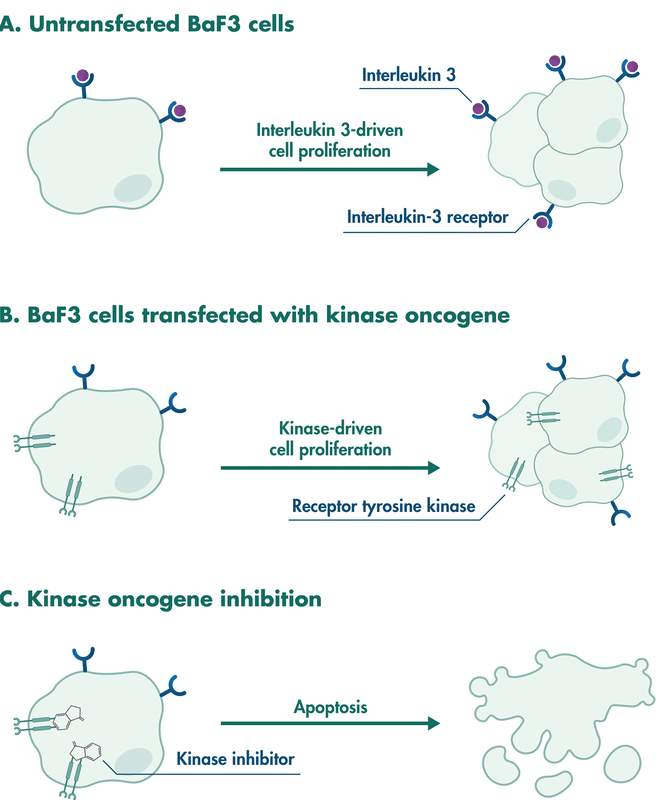
The overexpression of receptor tyrosine kinases enables the interleukin 3-dependent Ba/F3 cell line to grow without the supplement of interleukin 3. The inhibition of the activity of the transforming kinase leads to the loss of growth stimuli resulting in cell apoptosis.
It is a functional, cell-based assay for kinase inhibitors. BaF3 cells engineered to depend on a transforming kinase are treated with a compound, and inhibition of that kinase removes the survival signal, so loss of proliferation reports on-target activity as an IC50.
BaF3 cells normally depend on interleukin-3, but expression of a constitutively active kinase makes them kinase-dependent instead. This provides a clean, single-driver background with no interference from other kinases, and rapid growth suitable for potency and resistance studies.
Inhibitor potency as an IC50, derived from loss of cell proliferation. Proliferation is quantified by CellTiter-Glo luminescent ATP detection, with alternative readouts available.
An optional, parallel arm supplemented with interleukin-3 restores IL-3-driven growth. If a compound still inhibits proliferation under IL-3 rescue, the effect is non-specific rather than on-target kinase inhibition.
Some receptors, such as KIT wild type, EpoR, and MPL, do not transform BaF3 cells by overexpression alone and require concurrent ligand co-stimulation. These cytokine-receptor lines broaden the assay beyond standard transforming receptors.
Yes. New oncogenic driver, fusion, and resistance-mutant lines are built to order as a project deliverable. This bespoke, project-driven approach is the most common way programs engage the service.
CellTiter-Glo luminescent ATP is standard. Alamar Blue, MTT, CyQuant, and IncuCyte real-time imaging are available as alternatives.
Cells are dosed the day after seeding and incubated for 48 to 72 hours before the proliferation readout, with activation-dependent lines run under concurrent ligand stimulation.