
Reaction Signals Q3 2026 Newsletter

Headlines In This Issue
Scientific Spotlight
Our biochemical kinase platform, including HotSpot™ and ³³PanQinase™, comprise the largest kinase library in the industry.
Featured Research
Two new studies on kinase polypharmacology: a Nature Biotechnology paper co-authored with Reaction Biology scientists profiling 92 clinical kinase inhibitors against 758 kinases to expand the druggable kinome from 89 to 235 targets, and a Science paper identifying 117 kinases, including EGFR, that directly regulate RNA Polymerase II
Webinar
Taran Gujral, PhD (Fred Hutchinson Cancer Center), on what 65,000+ kinase-drug interactions reveal about repurposing and resistance
New at Reaction Biology
Preclinical irradiation services, expanded clinical trial biomarker testing, and NanoBRET panels now covering kinase mutants
Important Dates
Compound submission deadlines for multiple screening panels plus upcoming conferences.
Scientific Spotlight
Kinase Polypharmacology, From Data to Application
Kinase inhibitors are designed against a primary target, but their pharmacological activity rarely stops there. Reaction Biology’s platform maps the full picture.
HotSpot™ is our radiometric filter-binding assay, the gold standard for functional inhibition data
- 850+ kinase panel
- ATP options from 1 µM to 1 mM
- Comprehensive MOA studies (ATP-competitive, substrate-competitive, allosteric)
³³PanQinase™ independent panel via radioisotope FlashPlate assay, run from our Freiburg facility
KinaseFinder turns the question around: rather than screening inhibitors against kinases, it identifies which kinases phosphorylate a protein or peptide of interest.
Where a validated substrate does not yet exist for a kinase of interest, our Kinase SubstrateFinder identifies one, ensuring assay development does not become a rate-limiting step.
Collectively, these platforms deliver the largest kinase library in the industry, direct activity measurement against native, unmodified substrates, and screening at physiological ATP concentrations without loss of assay sensitivity.
Featured Research
Direct Targeting and Regulation of RNA Polymerase II by Cell Signaling Kinases
Kinase polypharmacology doesn’t stop at other kinases, it can reach all the way into the transcriptional machinery itself. This study screened roughly 80% of the human kinome, 427 kinases, against the C-terminal domain (CTD) of RNA Polymerase II, the site that gets phosphorylated at different stages of transcription to recruit the right processing machinery at the right time.
The established view was that a small handful of CDKs (CDK7, CDK9, CDK12) control this process by modifying two well-characterized CTD residues. Utilizing Reaction Biology’s Hotspot KinaseFinder services, this study found something much broader: 117 kinases, spanning diverse families well beyond the CDK group, selectively phosphorylate three previously uncharacterized “orphan” CTD residues, each with notable positional specificity rather than indiscriminate activity.
The most unexpected finding involves EGFR. Best known as a plasma membrane receptor tyrosine kinase, EGFR was shown to traffic into the nucleus and directly hyperphosphorylate Pol II, selectively switching on the earliest signal-responsive genes. It’s a direct, mechanistic link between a cell-surface signaling event and gene transcription, with a kinase most researchers would never have flagged as a transcriptional regulator.
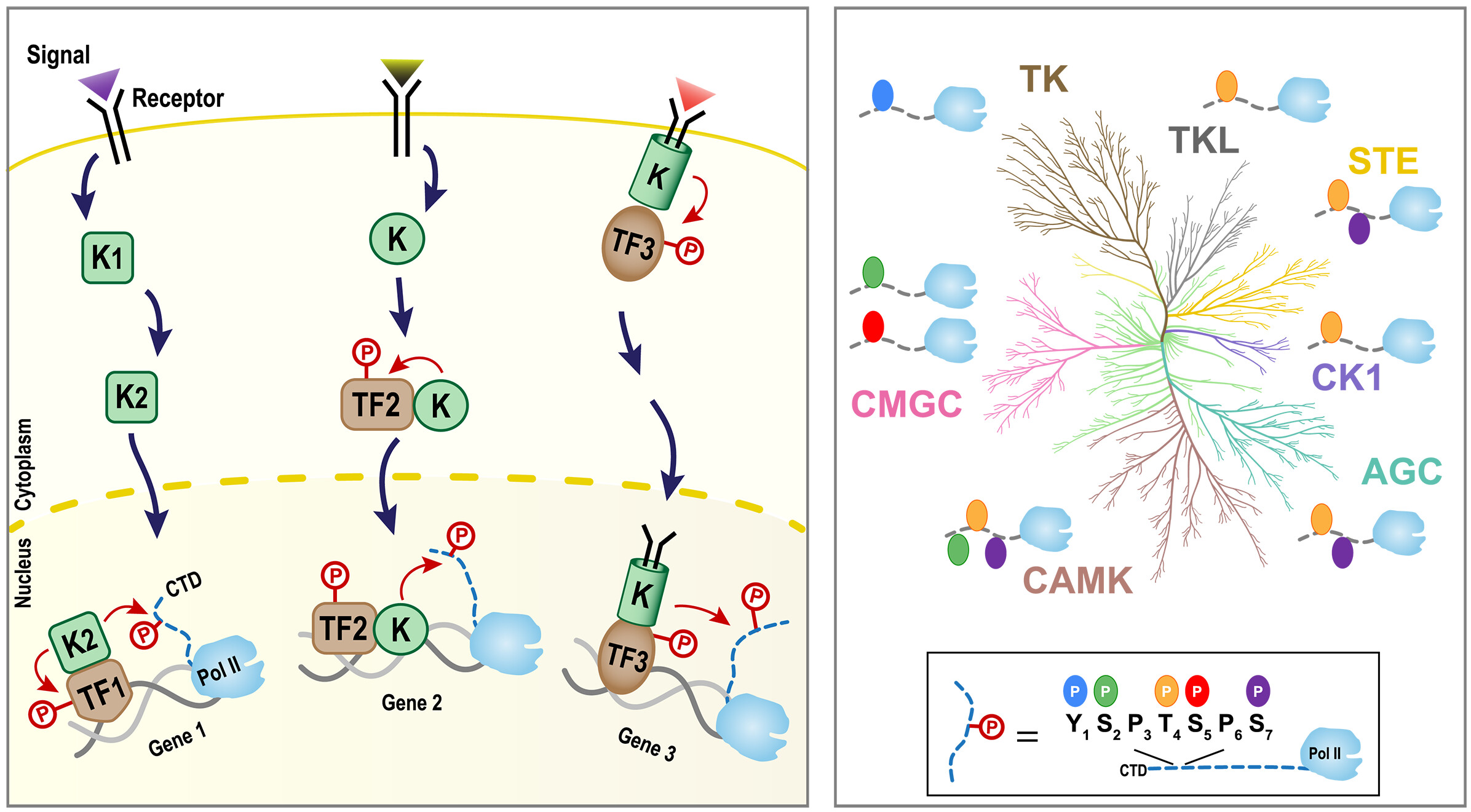
Figure: Signal-transducing kinases act on RNA Pol II at target genes
Why it matters for your program: if a kinase inhibitor’s target has any role in signal transduction, its effects may not stop at its canonical pathway; they can extend directly into transcriptional control. This is exactly the kind of unexpected polypharmacology that comprehensive kinome profiling, biochemical and cellular, is built to catch before it surfaces as an unexplained phenotype downstream.
Comprehensive Profiling of Clinically Approved Kinase Inhibitors Reveals Mutation-Specific Inhibitors and Opportunities for Drug Repurposing
In a collaboration between Reaction Biology and Fred Hutchinson Cancer Center, researchers profiled 92 clinical kinase inhibitors, 86 of them FDA-approved, against 758 kinases using Reaction Biology’s HotSpot™ biochemical assay platform: 409 wild-type kinases plus 349 oncogenic mutants and gene fusions. It’s the most comprehensive kinase inhibitor profiling effort published to date.
The headline finding: the drugs tested were originally designed against 89 primary kinase targets, but the data show they collectively engage 235 kinases, a more than twofold expansion of the druggable landscape using medicines already in clinical use. Even more striking, 94% of the cancer-associated kinase mutations and 97% of the gene fusions tested were inhibited by at least one existing approved drug.
The team didn’t stop at the biochemical data. They validated three repurposing candidates experimentally:
- Tepotinib (approved as a MET inhibitor) as an IRAK1/4 inhibitor that suppresses glioblastoma growth via a cholesterol-efflux mechanism, confirmed in patient-derived xenografts
- Brigatinib (approved as an ALK inhibitor) as a MARK2/3 inhibitor that shuts down Hippo-YAP signaling in pancreatic cancer models
- Gilteritinib (approved as an FLT3 inhibitor) as an effective inhibitor of MET mutants that drive resistance in lung cancer, including variants no approved MET inhibitor could touch
To make the full dataset usable, the team also released KIRHub, a free web-based portal where researchers can look up which existing drugs hit a kinase or mutation of interest.
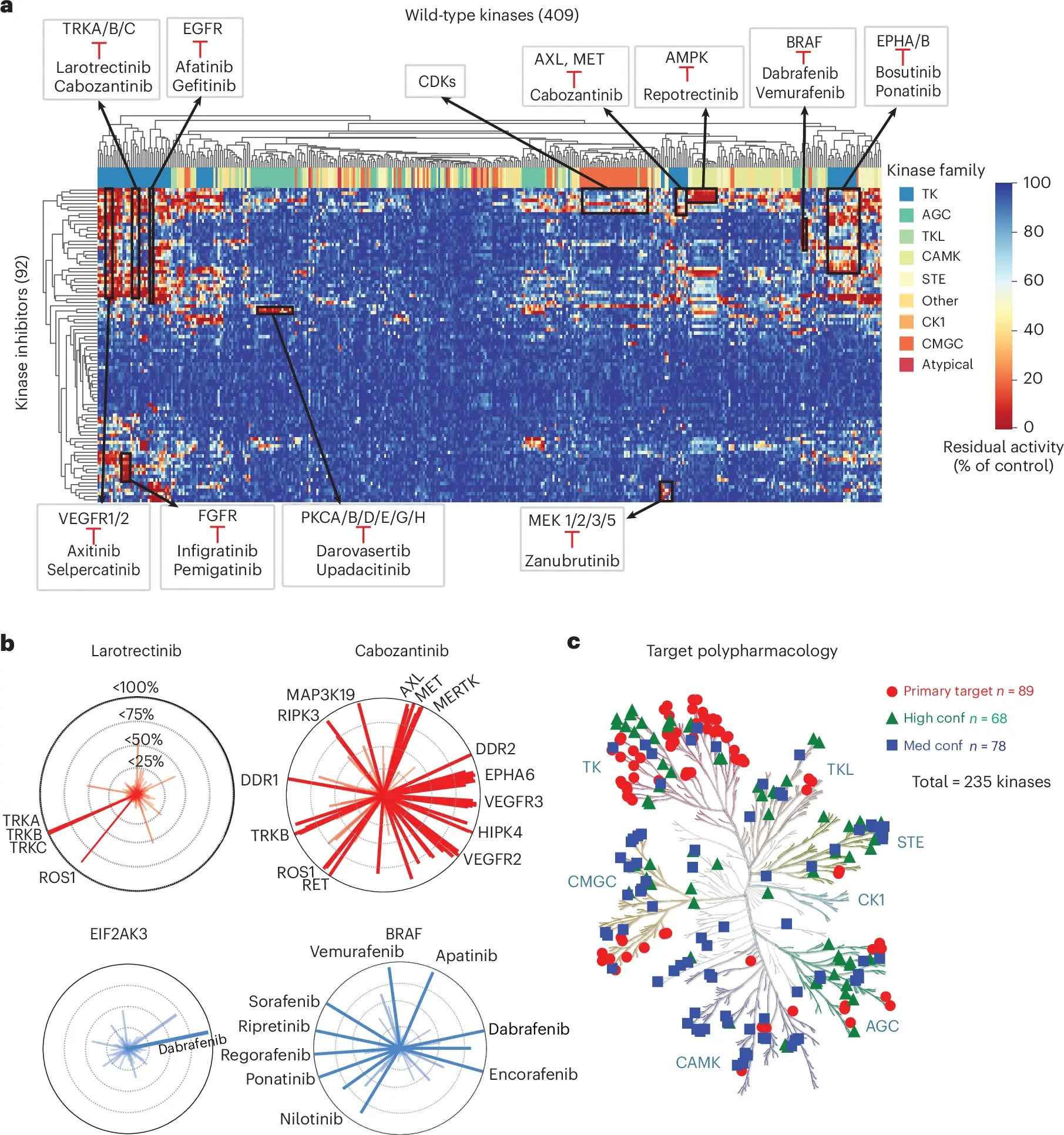
Figure: Profiling the inhibition of 92 drugs across 409 kinases
Read the paper in Nature Biotechnology →
Recorded Webinar
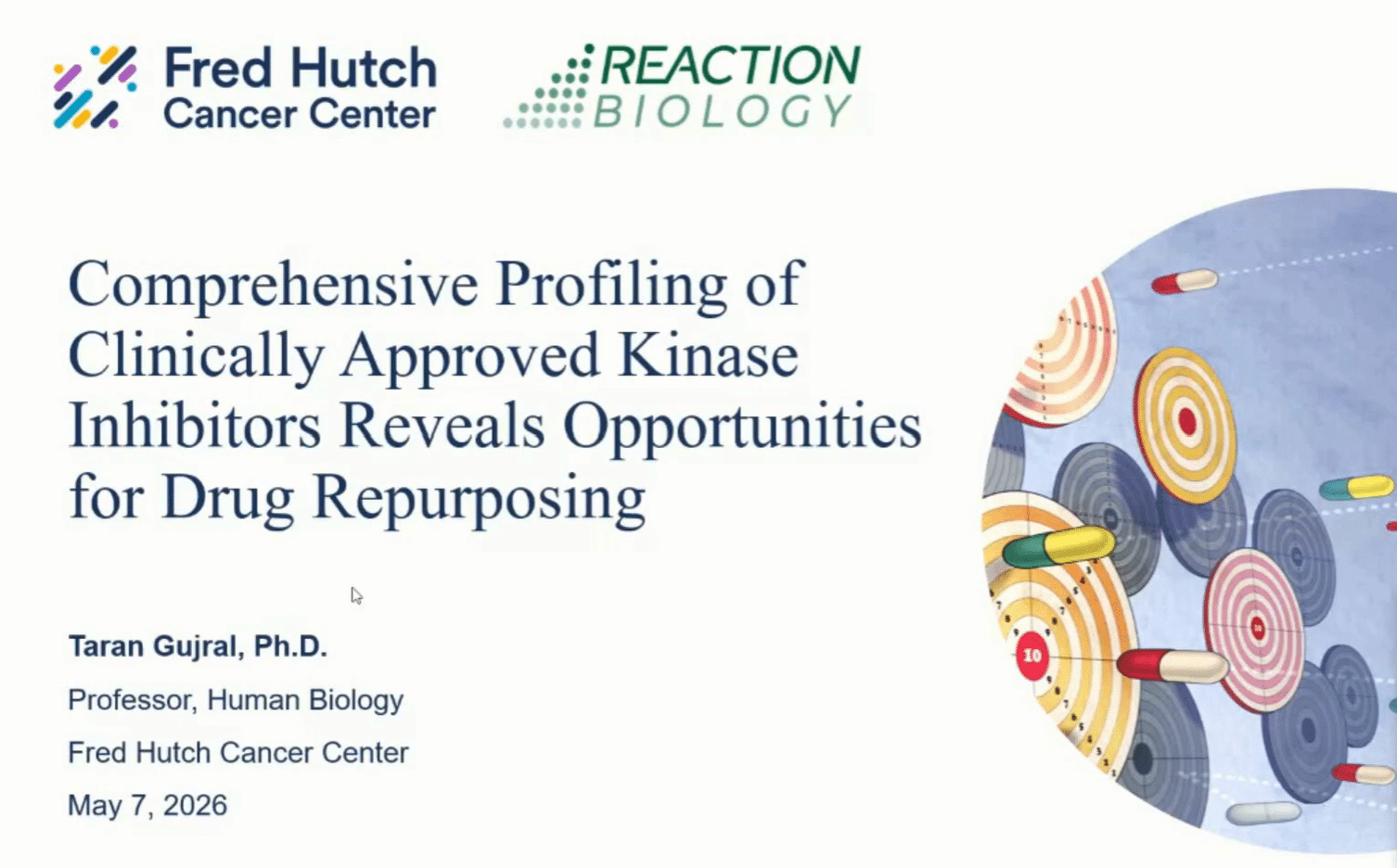
Beyond Primary Targets:
What 65,000+ Kinase-Drug Interactions Reveal About Repurposing and Resistance
Access our recorded webinar with Taran Gujral, PhD, Fred Hutchinson Cancer Center, who walks through the dataset behind the paper above and three case studies where it pointed to a repurposing opportunity: an existing MET inhibitor repurposed against IRAK1/4 in glioblastoma, an FLT3 inhibitor reversing epithelial-mesenchymal transition in breast cancer, and an ALK inhibitor suppressing a Hippo-pathway target in pancreatic cancer. Dr. Gujral also demos KIRHub, the free portal for exploring the dataset.
Product Highlights
Preclinical Irradiation Services
Reaction Biology now offers focused and whole-body preclinical irradiation from our Freiburg, Germany and Hershey, PA campuses, enabling study designs that mirror clinical radiation-drug combination regimens.
- XenX (Freiburg): Portal imaging-guided, 3D conformal irradiation for tumor-specific dosing, radiosensitizer screening, and abscopal effect studies. ISO 9001 and GV-SOLAS certified.
- X-RAD 320iX (Hershey): Whole-body and shielding-based localized irradiation for bone marrow ablation, immune reconstitution, and total body conditioning. AAALACi accredited.
- Supports radiation-drug combinations, immuno-radiation studies, and in vitro radiosensitivity profiling across xenograft, syngeneic, and humanized models
Learn more about Preclinical Irradiation →
Clinical Trial Biomarker Testing
A new exploratory endpoint analysis service for Phase 1/2 trials, bridging preclinical biomarker strategy directly into the clinic without the cost or timeline of a fully GCLP-qualified program.
- Plasma Inhibitory Assay (PIA): Measures bioactive drug concentration in patient plasma rather than total drug levels, critical for highly protein-bound compounds. Validated for FLT3, BCR-Abl, EGFR, VEGFR2, HPK1, and Aurora kinase, with additional targets available on request
- Serum & Plasma Biomarker Profiling: Up to 18+ cytokine, chemokine, and growth factor analytes from a single sample via MSD electrochemiluminescence
- Phospho-Target Profiling & Immunophenotyping: Confirms target engagement directly from patient PBMCs or whole blood (pSTAT5, pERK1/2, pFLT3, pp38), with shipment-friendly, ambient-temperature compatible sampling
- Seamless transition path to fully GCLP-qualified testing through our sister Bioassay campus when markers advance toward regulatory use
Learn more about Exploratory Biomarker Testing →
Expanded NanoBRET™ Kinase Panels, Now Covering Mutants
Our NanoBRET™ cellular target engagement panels now include kinase mutants alongside wild-type targets, giving you live-cell confirmation of compound activity against the exact variant driving your program.
Learn more about NanoBRET Target Engagement →
Upcoming Screening Schedule
Ensure your compounds are included in our upcoming screening runs.
Please note the following deadlines for sample submission.
Request a quote for compound screening →
| Bromodomain Full Panel | July 31 | September 4 |
| Protease Full Panel | July 24 | August 21 | September 25 |
| Phosphodiesterase (PDE) Full Panel | July 24 | August 21 | September 25 |
| ProLiFiler™ Cancer Cell Panel | September 3 |
| Histone Deacetylase (HDAC) Full Panel | July 31 | September 4 |
| InVEST18/44/59/77 Safety Panels | August 7 | September 4 |
| Methyltransferase Full Panel | July 31 | August 14 | September 4, 18 |
| Kinase Panel Screening (US Facility) | |
|---|---|
| Full Panel | July 29 | August 12, 26 | September 9 |
| 1 mM ATP (Wildtype, Mutant, Atypical, Lipid, and Diacylglycerol) | July 22 | August 19 | September 16 |
| Diversify Panel | August 5 | September 2 |
| Kinase Panel Screening (German Facility) | |
|---|---|
| Full Panel (Wild Type, Mutant, Diversify, Lipid) | July 30 | August 27 |
Conferences and Events
European Bioassay Conference
- Seville, Spain | September 23-25
- Attendee: Luisa Duque, PhD
Discovery on Target
- Boston, MA | September 28 – October 1
- Attendees: Kelli Clayton and Safnas Abdul Salam, PhD
About Reaction Biology
A partner that reduces risk at every milestone
Reaction Biology is a consultative drug discovery and development CRO that elevates the standard for collaboration, scientific rigor, and data quality.
For 25 years, we’ve helped advance novel therapeutics by delivering reliable, timely data to 2,500+ clients worldwide. Hundreds of therapies submitted for IND were supported by our science, because a partner you can trust helps reduce risk at every milestone.
With four strategically positioned facilities across the US and Europe, an integrated assay portfolio spanning biochemical, cellular, biophysical, safety, and in vivo capabilities, and gold-standard methodologies backed by ISO 9001:2015 quality management, we deliver the speed and scientific rigor your program demands.
Let’s discover together.
References
Saifudeen, M., Zhu, S., Liang, S., Eason, M., Goupil, A., Mische, D. F., Loch, C. M., Ma, H., Chan, M., & Gujral, T. S. (2026). Comprehensive profiling of clinically approved kinase inhibitors reveals mutation-specific inhibitors and opportunities for drug repurposing. Nature Biotechnology. https://doi.org/10.1038/s41587-026-03090-8
Dabas, P., Cutrona, M. B., Rosikiewicz, W., Kempen, R. P., Rodrigues, P., Bowling, J., Prater, M. S., Lang, W. H., Danda, A., et al., & Ansari, A. Z. (2025). Direct targeting and regulation of RNA polymerase II by cell signaling kinases. Science, 390(6773). https://doi.org/10.1126/science.ads7152


