
Metabolic Mechanism of Action
Confirm that compounds act on NAD+ biosynthesis, such as NAMPT inhibitors, by measuring depletion of the cellular cofactor pool.
Quantify compound effects on cellular NAD(H) in a sensitive, HTS-ready luminescent assay
Measure total intracellular NAD+ and NADH after compound treatment to confirm metabolic mechanism of action, quantify pharmacodynamic response, and assess effects on redox balance and mitochondrial function.
NAD+ and NADH regulate energy metabolism, redox balance, mitochondrial function, and cell viability. They also fuel NAD+-dependent signaling enzymes such as PARPs and sirtuins. When a compound disrupts how cells make or consume these cofactors, the change in the NAD(H) pool is a direct readout of its metabolic mechanism.
Our Cellular NAD/NADH Assay is a homogeneous, luminescence-based method that quantifies total NAD/NADH directly in cultured cells. After compound treatment, a single detection reagent lyses the cells and extracts the cofactors. An enzyme-coupled cycling reaction then converts NAD(H) into a luminescent signal proportional to the amount present. The add-and-read workflow is compatible with high-throughput screening and delivers IC50 data, with the NAMPT inhibitor FK866 included as a reference compound in every study.
Confirm that compounds act on NAD+ biosynthesis, such as NAMPT inhibitors, by measuring depletion of the cellular cofactor pool.
Use cellular NAD(H) levels as a quantitative readout of pathway engagement and dose response across cell lines.
Assess how compounds affect cellular energy metabolism, mitochondrial activity, and redox status.
Evaluate how modulating NAD+-consuming pathways, such as PARP and sirtuin signaling, affects the cellular cofactor pool.
Approach
Measure depletion of cellular NAD(H) by FK866 (Daporinad), a potent and highly selective inhibitor of nicotinamide phosphoribosyltransferase (NAMPT), the rate-limiting enzyme in the NAD+ salvage pathway.
Setup
HepG2, Jurkat, and MDA-MB-231 cells were seeded into 384-well plates and treated with serial dilutions of FK866 for 72 hours. NAD/NADH detection reagent was added to each well and luminescence was measured on an EnVision 2104 Multilabel Reader. IC50 values were calculated in GraphPad Prism using a sigmoidal dose-response fit.
Results
FK866 depleted total NAD/NADH in a concentration-dependent manner in all three cell lines, with IC50 values of 0.39 nM (Jurkat), 0.95 nM (HepG2), and 5.4 nM (MDA-MB-231), and near-complete depletion at the highest concentrations tested.
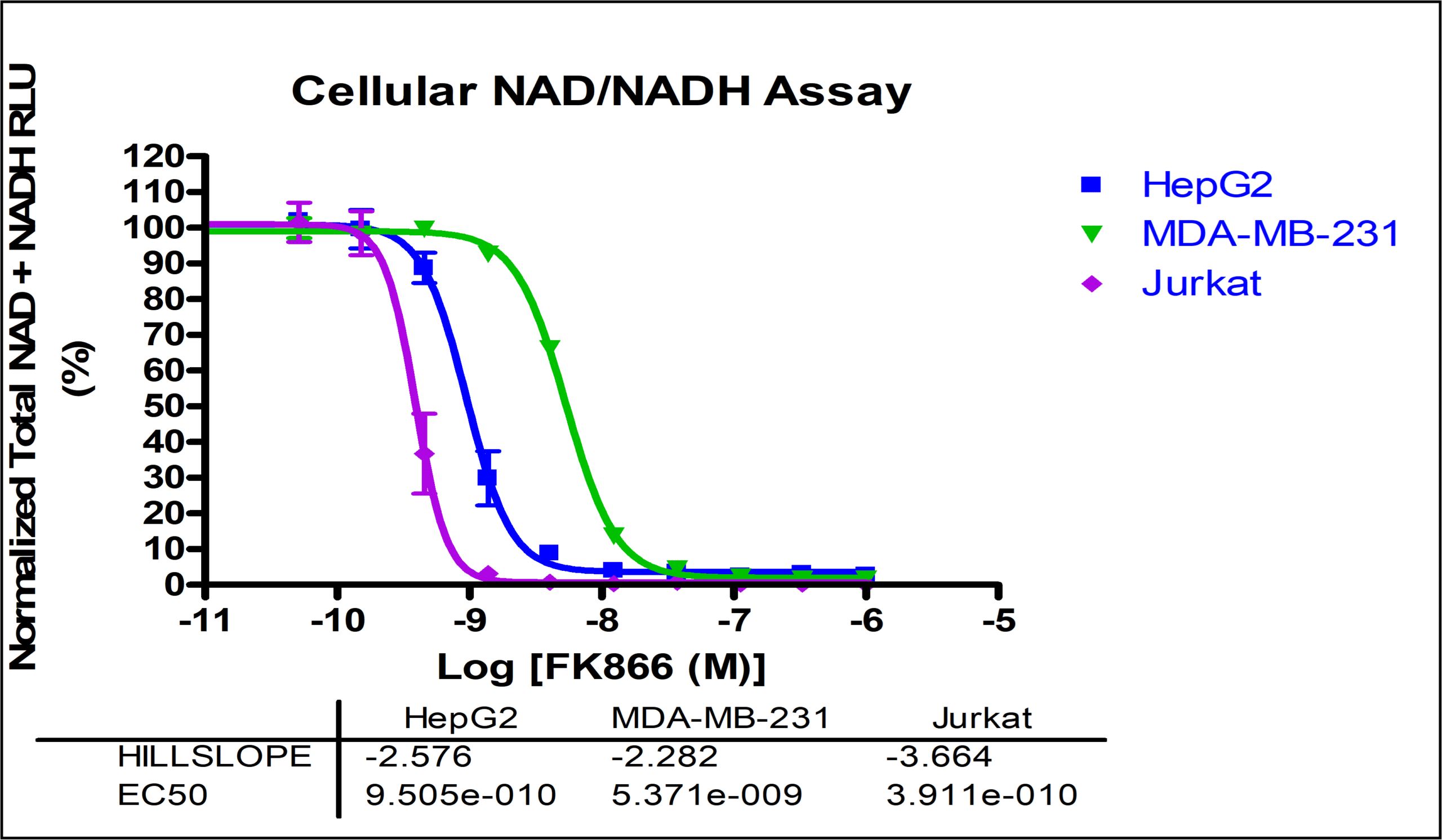
Normalized total NAD + NADH (%) in HepG2, MDA-MB-231, and Jurkat cells after 72-hour FK866 treatment.
| Parameter | Details |
|---|---|
| Readout | Luminescence, proportional to total cellular NAD+ and NADH |
| Setup | IC50 determination |
| Format | 384-well microplates |
| Validated cell lines | HepG2, Jurkat, MDA-MB-231; additional cell lines on request |
| Controls | DMSO negative control. FK866 reference compound included free of charge in every IC50 project |
| Turnaround | 3 weeks. Expedited scheduling and data delivery can be arranged before study start |
| Deliverables | Detailed report with assay conditions, methodology, and data evaluation, plus raw data |
| Compound requirements | 50 µL of stock solution at 1000x the highest assay concentration, or 2 mg of solid material |
| Location | Malvern, Pennsylvania, USA |
The assay quantifies total NAD+ and NADH in cultured cells after compound treatment. The luminescent signal is directly proportional to the amount of NAD(H) present, giving a quantitative readout of how a compound affects the cellular cofactor pool.
Viability assays such as CellTiter-Glo measure ATP as a proxy for the number of live cells. This assay measures the NAD(H) pool itself, which gives a mechanistic readout of metabolic disruption. Running both helps separate metabolic effects from general cytotoxicity.
The assay has been validated in HepG2, Jurkat, and MDA-MB-231 cells. Additional cell lines can be tested on request. Contact us to discuss the models relevant to your program.
DMSO serves as the negative control. The NAMPT inhibitor FK866 is included as a reference compound in every IC50 project at no additional charge.
Standard turnaround is 3 weeks, and expedited scheduling can be arranged before the study starts. You receive a detailed report covering assay conditions, methodology, and data evaluation, along with the raw data.
We need 50 µL of stock solution at 1000x the highest assay concentration, or 2 mg of solid material.