Read our latest blog: LinkLight™ Protein-Protein Interaction AssaysLearn More

Cell Line Generation
Custom Services

Cell Line Generation Services

Custom cell lines serve as essential tools throughout preclinical drug discovery. Genetically engineered cells stably expressing foreign proteins enable reproducible screening assays, long-term expression studies, and in vivo imaging applications. Unlike transient transfection, which produces variable expression that diminishes over days, stable cell lines maintain consistent transgene expression across passages, delivering the reliability required for dose-response studies, compound profiling, and high-throughput screening.

Reaction Biology’s Cell Line Generation Services support a range of applications including reporter cell lines for bioluminescence imaging and in vivo tumor tracking, overexpression lines for studying your protein of interest, labeled cell lines for proliferation and viability assays, and custom modifications for target validation or disease modeling.

Service Procedure & Deliverables

Two Proven Approaches for Genetic Modification

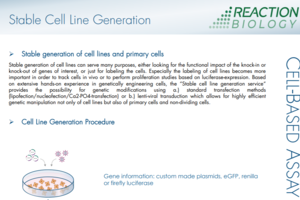
Based on extensive experience generating custom cell lines across diverse cell types, Reaction Biology employs two established methods for stable gene integration:

  • Standard Transfection Methods: Lipofection, nucleofection, and calcium phosphate (Ca₂PO₄) transfection provide reliable delivery for commonly used cell lines. These approaches are well-suited for cells with high transfection efficiency and projects requiring rapid turnaround.
  • Lentiviral Transduction: Lentiviral vectors enable highly efficient genetic manipulation of a broader range of cell types including: primary cells, hard-to-transfect lines, and non-dividing cells. This method achieves stable integration at transcriptionally active sites, resulting in robust, long-term expression with minimal clone-to-clone variability.

How It Works

  • Gene Information & Construct Design: Provide your gene sequence (RefSeq accession, sequence file, or plasmid). Our team designs and constructs the optimal expression vector with appropriate promoters and selection markers for your target cell type.
  • Gene Delivery: We introduce your construct via the most suitable method (transfection or lentiviral transduction) based on your cell line and expression requirements.
  • Selection & Clone Isolation: Antibiotic selection or cell sorting eliminates untransduced cells. We isolate and expand stable clones to establish homogeneous populations with confirmed integration.
  • Expression Analysis & QC: Expression is validated using appropriate methods such as flow cytometry (FACS), Western blot, qPCR, reporter assays, or imaging, depending on gene of interest.

Standard Deliverables

  • Minimum 2 million viable cells (dependent on project scope and licensing)
  • Polyclonal pool or monoclonal clones (based on project requirements)
    • Polyclonal: Selected cell pool with confirmed transgene expression. Recommended for faster timelines and screening applications.
    • Monoclonal: 1–2 validated single-cell clones with uniform expression. Recommended for quantitative assays and long-term studies.
  • Expression analysis data sheet with QC documentation
  • Detailed project report including methods, validation results, and cell handling recommendations

Service Workflows

  • Stable Cell Line Generation
Stable Cell Line Generation

Generate robust, reproducible cell lines with stable expression of your gene of interest. Ideal for reporter assays, drug screening panels, in vivo imaging, and long-term functional studies.

Typical Applications

  • Luciferase-expressing tumor lines for in vivo bioluminescence imaging and xenograft studies
  • Fluorescent protein (GFP/RFP) labeled lines for proliferation tracking and cell-based screening
  • Overexpression or knockdown lines for target validation
  • Reporter cell lines (e.g., GPCR, pathway reporters) for functional assays

Process Timeline