
Read our latest blog: LinkLight™ Protein-Protein Interaction AssaysLearn More

Patch Clamp Assay
Ion Channel Drug Discovery

Patch Clamp Assay Services

Our fully automated patch clamp platform comprises QPatch HTX and QPatch 16 that allows for the testing of up to 48 or 16 cells in parallel, respectively.

QPatch are medium-throughput machines suitable for confirming hits from larger screens and also for lead optimization. QPatch offers high-quality measurements with the formation of gigaohm seals. The platform can be used to assay both voltage-gated and ligand-gated channels and utilizes stable cell lines.

  • Compound profiling against the Cardiac Safety Panel including hERG, Nav1.5, and Cav1.2
  • Positive control and vehicle control in every assay
  • Single concentration profiling and full concentration-response curves

Whole-Cell Patch Clamp Assay Principle

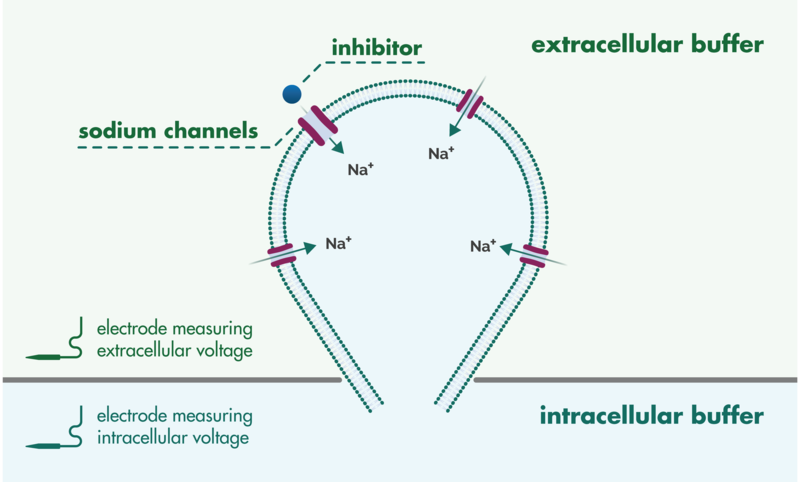
Whole-cell patch clamp technique briefly applies large suction to a part of the cell membrane causing disruption and a closed gigaohm seal to allow the cytosol to be one sphere with the intracellular buffer chamber. Currents from the ion flux of the entire cell are measured via electrodes.

whole-cell patch clamp technique measures the activity of ion channels based on an electrode outside of the cell and inside the patch clamp devise which builds one liquid sphere with the cell cytomplasm via a rupture of the plasma membrane

whole-cell patch clamp technique measures the activity of ion channels based on an electrode outside of the cell and inside the patch clamp devise which builds one liquid sphere with the cell cytomplasm via a rupture of the plasma membrane

Patch Clamp Assay Details

  • Automated IonFlux Platform
  • Manual Patch Clamp Platform
Automated IonFlux Platform

The Cell Microsystems (Fluxion) IonFlux Mercury 16 is a fully automated patch clamp platform that allows for the testing of up to 16 cells in parallel. This is a medium-throughput platform great for confirming hits from larger screens and also for lead optimization. The IonFlux offers high-quality measurements with the formation of near gigaohm seals. The platform can be used to assay both voltage-gated and ligand-gated channels and utilizes stable cell lines.

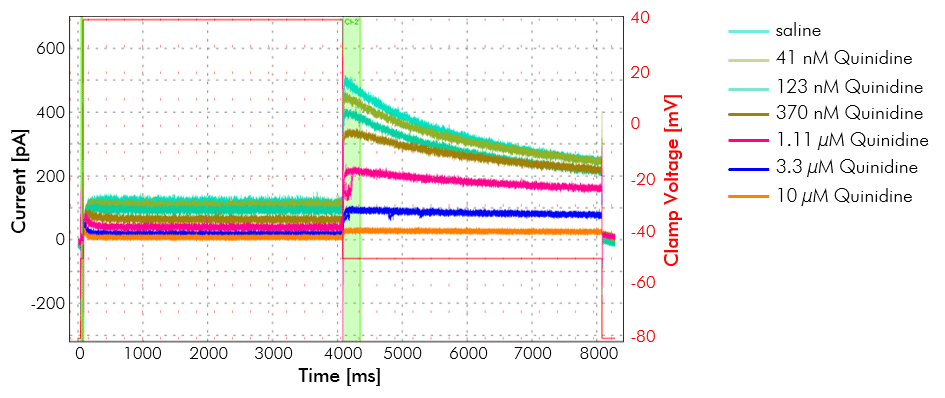
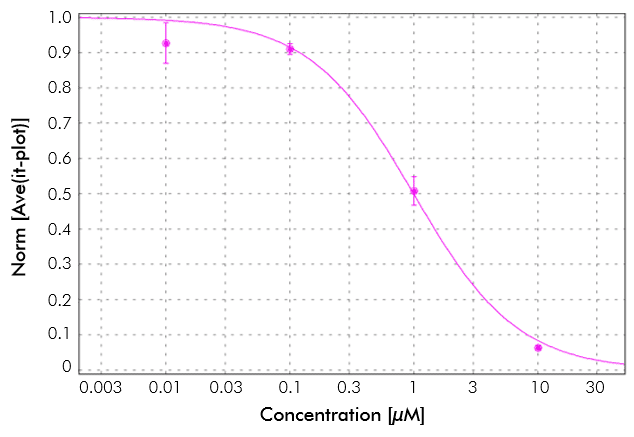
hERG testing example with Qpatch for compound testing of cardiac safetyExample of hERG inhibition. hERG potassium channel inhibition in the presence of various concentrations of an antiarrhythmic agent. Recordings were made on the IonFlux in CHO cells stably expressing hERG voltage-dependent potassium channel. Each concentration of the drug was perfused for 5 minutes. A drug concentration of 10 µM shows close to complete inhibition of hERG.
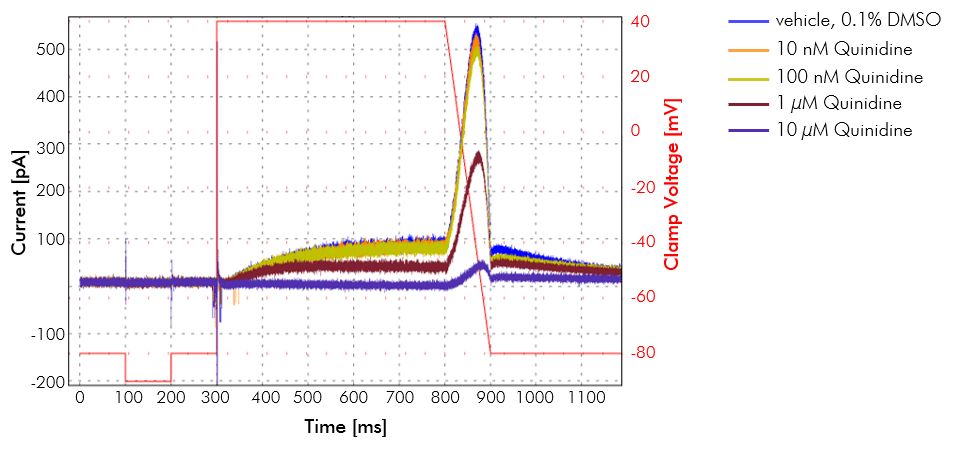
 

trace of hERG currents in QPatch for compound testing of cardiac safety

Example of inhibition of hERG currents by an antiarrhythmic agent. Peak hERG currents were elicited by a ramp down from +40 mV to -80 mV.


time/current plots for herg on qpatch for drug testing

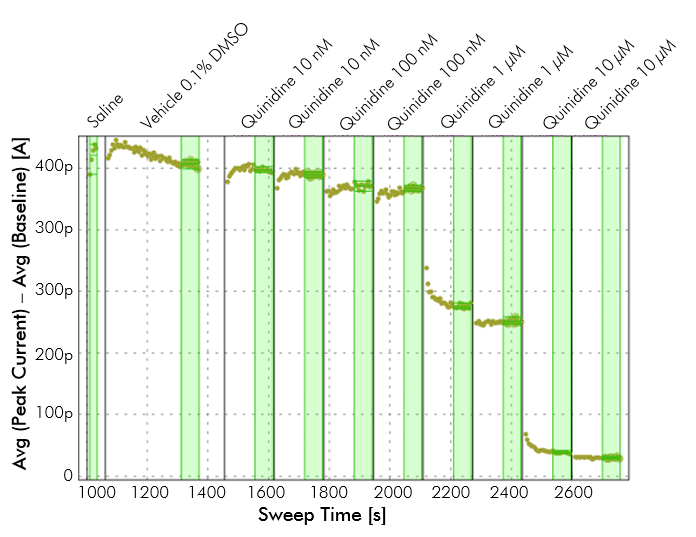
Resulting time/current plots from IonFlux.
 

dose response curve of testing herg for cardiac safety

Currents were normalized to the negative control peak current and plotted as % inhibition.

Manual Patch Clamp Platform

Manual patch clamping is the “gold-standard” for the investigation of ion channel activity. In addition to confirming the activity of potential hits from high or medium-throughput screens, manual patch clamping can be used to assess the mechanism of action of compounds and to determine the effects of compounds on the biophysical properties of a channel. Both voltage-gated and ligand-gated channels can be tested using manual patch clamping. This system utilizes stable cell lines or native cells (neurons, cardiomyocytes, etc.).

FAQs

What is a patch clamp assay?

A patch clamp assay is an electrophysiological technique used to study ionic currents through individual ion channels in cells. By forming a high-resistance seal between a glass pipette and the cell membrane, researchers can measure the activity of specific ion channels, providing insights into their function and how they are affected by various compounds.

What types of ion channels can be studied using patch clamp assays?

Patch clamp assays can be applied to a variety of ion channels, including voltage-gated channels (e.g., sodium, potassium, calcium channels), ligand-gated channels (e.g., GABA, glutamate receptors) and mechanosensitive channels. This versatility makes the technique valuable for studying a wide range of physiological and pharmacological processes.

What are the advantages of using patch clamp assays in drug discovery?

Patch clamp assays offer high-resolution measurements of ion channel activity, allowing for precise characterization of drug effects on channel function. This level of detail is crucial for understanding the mechanism of action of compounds, assessing their potency and selectivity, and identifying potential off-target effects, thereby informing lead optimization and safety assessments in drug discovery.

What’s the difference between manual and automated patch clamp?

Manual patch clamp is more flexible and sensitive but low-throughput. Automated patch clamp uses robotics for greater reproducibility and throughput, useful for screening large compound libraries.

What cell lines does Reaction Biology use in patch clamp assays?

Reaction Biology uses CHO and HEK stable cell lines expressing specific ion channels such as hERG, NaV1.5 and CaV1.2, optimized for automated patch clamp assays.