
Read our latest blog: LinkLight™ Protein-Protein Interaction AssaysLearn More

Cell Migration Assays (Wound Healing Assay)
Cell-Based Assays

Cell Migration Assays (Wound Healing Assay)

Cell migration assays are essential tools for the investigation of tumor cell metastasis. The Wound Healing Assay (also known as Scratch Assay) measures how quickly cells close a defined gap in a confluent monolayer through undirected migration, providing a functional readout of compound effects on cell motility.

Cell migration is a hallmark of cancer progression and metastatic disease. It enables angiogenesis to support tumor growth and drives metastasis, where tumor cells leave the primary site and invade distant tissues. This migratory process is triggered by growth factors, chemokines, and other stimuli, activating complex signaling cascades involving key components of the cellular motility machinery. Druggable targets such as FAK, cSrc, and ROCK, along with the ligand/receptor interactions that initiate migration, are promising opportunities for anti-metastatic drug development.

The Wound Healing Assay enables functional characterization of both migration inhibitors and promoters, supporting a range of high-throughput and combination treatment applications:

  • Target validation: Confirm the role of specific signaling pathways (e.g., FAK, Src, Rho/ROCK) in tumor cell motility
  • Compound screening: Evaluate anti-migratory potency of small molecules, biologics, or combination treatments in high-throughput formats

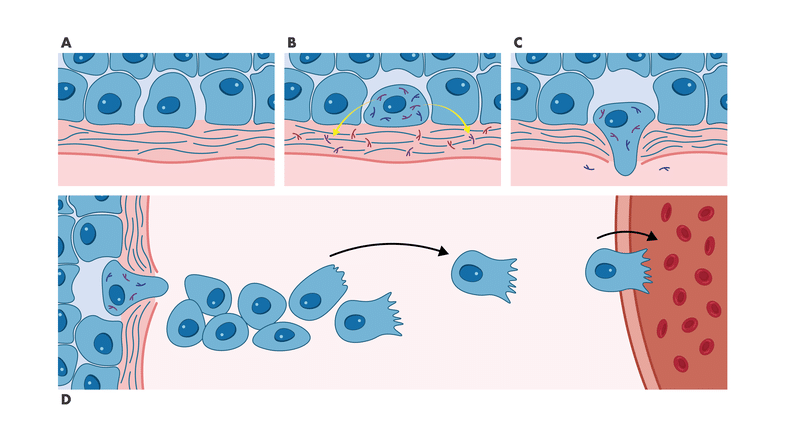
Early Metastasis Process

The early steps of metastasis involve
A) loosening of intercellular junctions between tumor cells,
B) degradation of the basement membrane extracellular matrix,
C) invasion into surrounding tissue, and
D) migration toward endothelial vessels.

tumor cell migration and invasion of tissue for metastasis

tumor cell migration and invasion of tissue for metastasis

Cell Migration Assay Details

  • Wound Healing Assay Description
  • Wound Healing Assay Example Data
  • Wound Healing Assay Details
Wound Healing Assay Description

Wound Healing Assay Description

The Wound Healing Assay (or Scratch Assay) measures the impact of compounds on undirected cell migration after wound-making via scratching the cell monolayer. The assay is suitable for investigation of tumor and normal cells and is performed with IncuCyte system which enables real-time monitoring of cell migration.

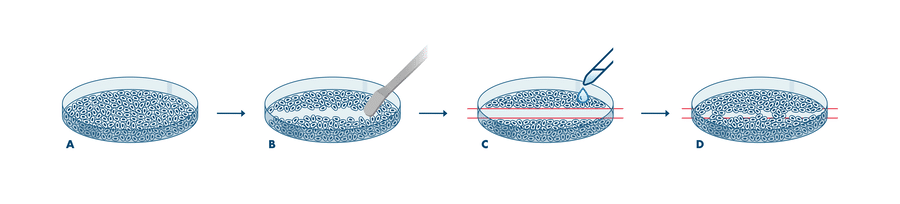
scratch assay procedure for compound testing on tumor cells for migration properties

Assay procedure. (A) Tumor cells grow to monolayers. (B) Using the WoundMaker, homogeneous scratches will be created mechanically with pins in a 96 well format. (C) After the application of the test compound, plates incubate in the IncuCyte S3 instrument for real-time quantification of tumor cells migrating into the scratch zone (D).

Wound Healing Assay Example Data

Wound Healing Assay Example Data

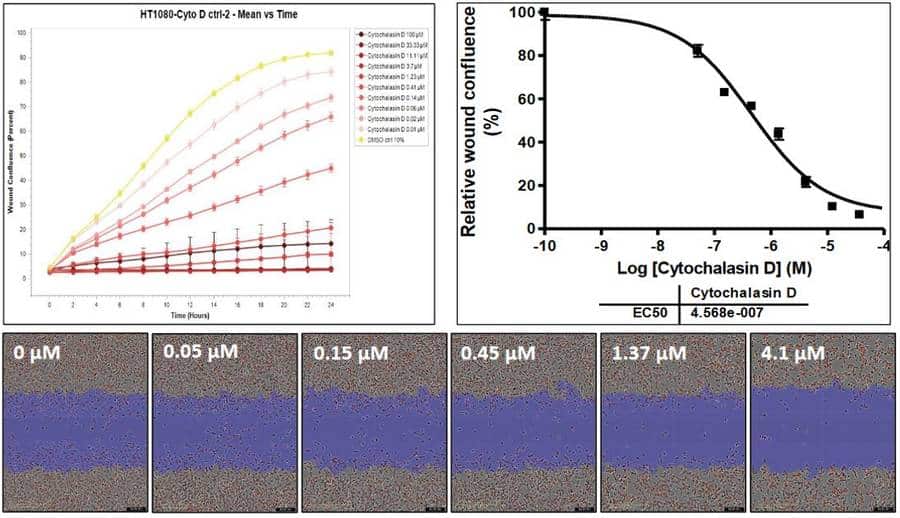
scratch assay example performed with incucyte for dose response studies for compound testing against migration of tumor cells

Effect of inhibition of cell migration on HT-1080 cells. HT-1080 cells with red fluorescence were seeded into ImageLock plates in complete growth media. After the cells reached about 90% confluence, wounds in all wells were simultaneously created using the WoundMaker tool. Cytochalasin D was added at serial dilutions and plates were placed in the IncuCyte instrument for scheduled scanning.

Upper left: Time course of the effect of an inhibitor of actin polymerization on wound healing over 24-hours. Upper right: Dose-dependent effect of the drug on wound healing at 8h time point. Lower panel: Representative images of wound healing at 8h time point. The blue areas represent the initial wound scratches.

Wound Healing Assay Details

Wound Healing Assay Details

Setup: IC50 value determination with 10 concentrations in triplicates performed in 96 well format. Drug combination testing is possible.

Controls: DMSO only control serves as high control. A reference compound recommended by the client is used for positive control.

Assay development: Custom-tailored assays can be performed. This assay can be established with new cell lines according to the client’s research needs.

Turnaround time: Around 3 weeks.

Report: Raw data, IC50 curves, and IC50 values as well as representative images of wound closure are provided in the report.

Screening facility: The assay is performed in Malvern, US.

Compound requirements: In brief, please provide 20-50 μl of 10-50 mM DMSO stock or the equivalent of solid powder. Please refer to our FAQs for information regarding compound preparation and shipping.