LinkLight<sup>™</sup> Protein Interaction Analysis Services

LinkLight Protein Interaction Analysis Services

Advance your programs with LinkLight assays, designed to capture fleeting protein-protein interactions and deliver insights that accelerate drug discovery.

Bring elusive biology to light with the LinkLight assay platform

LinkLight is a functional, cell-based platform delivering ultra-sensitive, highly-specific detection of protein-protein interactions. Traditional assays often miss transient interactions, but LinkLight assays capture physiologically relevant signals instantly, without relying on transcription. Built on TEV/luciferase cleavage, it’s ideal for studying GPCR and β-arrestin/14-3-3 pathways, while offering the specificity, sensitivity, and scalability you need.

  • Detects transient and low-affinity PPIs
  • Persistent, transcription-free signals
  • High sensitivity & specificity
  • Ideal for GPCR and β-arrestin/14-3-3 studies
  • Physiologically relevant outputs
  • Available with validated cell lines and custom service options
GPCR profiling that helps you see the full picture

GPCR profiling that helps you see the full picture

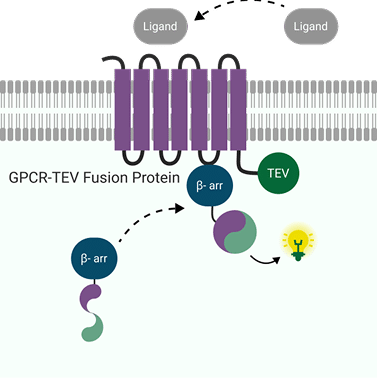
Secondary messenger cAMP and calcium assays capture immediate G-protein activation, but that’s only part of the picture. To fully understand GPCR activity, it’s important to evaluate regulatory β-arrestin recruitment that controls signal duration and can reveal ligand bias.

Use LinkLight to complete your GPCR characterization by adding β-arrestin/14-3-3 pathway analysis to your existing cAMP and calcium workflows.

How LinkLight works

How LinkLight works

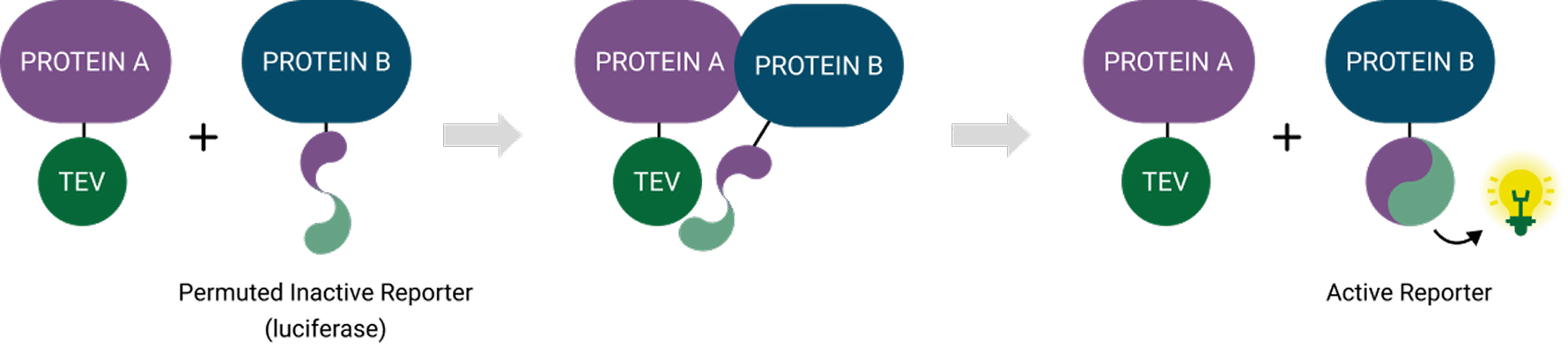
1. Tagging Proteins of Interest

LinkLight cell lines are engineered to tag two proteins of interest, A and B, involved in the interaction under study. Protein A is linked to a Tobacco Etch Virus (TEV) protease, while Protein B is fused to a permuted luciferase (pLuc).

This engineered luciferase contains rearranged fragments connected by a TEV protease cleavage sequence, ensuring it remains inactive in its native state.

2. Protein-Protein Interaction

When proteins A and B interact, the TEV protease is brought into close proximity with the cleavage site on the permuted luciferase. This proximity is the key to triggering the next step in the process.

3. Cleavage and Signal Activation

The TEV protease cleaves the permuted luciferase, allowing it to refold into an active conformation. In the presence of luciferin, the now-active luciferase generates a luminescent signal.

This signal is specific to the interaction between proteins A and B and remains functional even after the interaction ends, providing a persistent readout.

4. Signal Detection

The luminescent signal is detected instantly, offering immediate, transcription-free results. The reaction is non-reversible, meaning the signal is persistent and stable after even the briefest biological events.

Unlike other methods, LinkLight avoids high background noise and transcriptional delays, making it ideal for capturing transient, weak, or fleeting protein-protein interactions.

Key Features of LinkLight

Feature Description Benefit
Persistent signal Signal remains stable even after binding partners separate, enabling the detection of fleeting or transient protein interactions. Provides reliable insights into critical biological events, making it ideal for drug discovery and transient interaction studies.
Immediate, transcription-free results Protease cleavage generates signals instantly without the delays or variability of gene expression systems. Delivers physiologically relevant signals with minimal off-target effects, ensuring accurate and timely data for complex biological systems.
Specific and interference-free Only tagged receptors generate signals, preventing interference from endogenous receptors or receptor family members. Ensures high specificity and accuracy, even in dynamic and complex biological environments

Applications of LinkLight Technology

  • GPCR Profiling
  • Protein-Protein Interaction Analysis
  • Oncology and Immuno-Oncology
  • Neuroscience
  • Autoimmune Diseases
  • Musculoskeletal Health
  • Metabolic Disorders
GPCR Profiling

GPCR Profiling

LinkLight assays are compatible with a variety of receptors and signaling pathways, enabling comprehensive research across:

  • GPCR/β-arrestin signaling pathways: Monitor GPCR signaling cascades in addition to G-protein activation to identify β-arrestin-mediated therapeutic pathways with distinct pharmacological profiles.
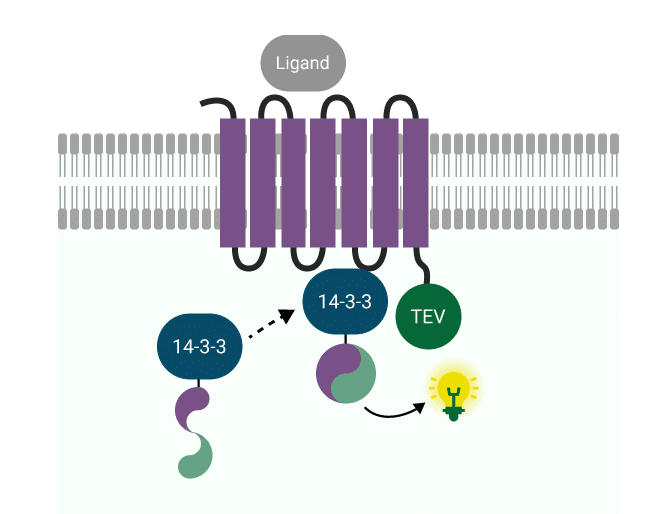
  • 14-3-3 downstream stabilization: Detect protein stabilization events downstream of GPCR activation using 14-3-3 scaffold proteins as a sustained signaling complex.
  • Pathway discovery for unknown GPCR coupling partners: Identify novel protein-protein interactions for orphan GPCRs.
  • Ligand bias profiling: Characterize drug selectivity for G-protein vs. β-arrestin pathways at the same GPCR target.
  • β-arrestin specific drug development: Design and validate compounds that selectively activate β-arrestin recruitment pathways.

Protein-Protein Interaction Analysis

Protein-Protein Interaction Analysis

LinkLight assays provide a versatile platform for probing diverse protein-protein interactions across cellular compartments and pathways.

  • Mechanism of Action (MoA) studies: Screen GPCR agonists and modulators with high-throughput screening (HTS) compatibility.
  • Membrane and cytoplasmic interactions: Investigate interactions between membrane-bound receptors and cytoplasmic proteins, such as those involved in signal transduction cascades.
  • Cell-cell interactions: Analyze interactions mediated by membrane proteins, critical for understanding intercellular communication.

Oncology and Immuno-Oncology

Oncology and Immuno-Oncology

LinkLight assay services empower oncology and immuno-oncology research with targeted analysis of GPCR signaling.

  • Tumor progression and metastasis: Investigate GPCRs implicated in tumor progression and metastasis, such as chemokine receptors CXCR4 and CXCR7, to reveal mechanisms driving cancer spread and identify novel therapeutic targets.
  • Immune modulation: Screen immune-related GPCRs, including adenosine receptors (e.g., A2A). These assays are particularly valuable for identifying targets that enhance anti-tumor immune responses.
Neuroscience

Neuroscience

Explore neurotransmitter receptors such as dopamine, serotonin, and glutamate receptors, which are essential for central nervous system (CNS) research and drug discovery. LinkLight provides accurate, specific insights into receptor signaling dynamics.

Autoimmune Diseases

Autoimmune Diseases

Investigate GPCRs involved in immune system regulation, such as sphingosine-1-phosphate receptors, to develop therapies for autoimmune conditions like multiple sclerosis and rheumatoid arthritis.

Musculoskeletal Health

Musculoskeletal Health

Study GPCRs like parathyroid hormone receptors, which play a role in bone and muscle health. LinkLight assays can help identify therapeutic targets for conditions such as osteoporosis and muscular dystrophy.

Metabolic Disorders

Metabolic Disorders

Screen metabolic GPCRs, including GLP-1, GIP, and glucagon receptors, to explore therapeutic strategies for diabetes, obesity, and other metabolic disorders.

Make the Fleeting Findable with LinkLight

Reach out today to learn how Reaction Biology’s LinkLight protein interaction analysis services can advance your discovery efforts.

Ask our team about LinkLight

Frequently asked questions

Got questions? We’ve got answers.

Are LinkLight assays suitable for high-throughput screening?

Yes, LinkLight assays are very well suited for HTS. LinkLight technology uses economical reagents and simple luminescent readouts with standard microplate readers, making it a cost-effective choice for large-scale studies.

Which cell lines are available with your LinkLight protein interaction analysis services?

Our LinkLight assay service offerings include 100+ GPCR/β-arrestin cell lines (see LinkLight cell line and target table). These cover the most commonly researched GPCR classes and signaling pathways.

We can also accommodate custom assays and plan to expand our portfolio with additional cell lines. Please contact us with any requests.

Why not rely solely on cAMP or calcium assays for functional GPCR studies?

While cAMP and calcium assays are valuable, they do not provide comprehensive GPCR characterization. Some biased agonists may not impact cAMP or calcium pathways, and these traditional assays can produce false positives from non-specific activation of endogenous GPCRs in the cell line.

Additionally, cAMP and calcium only detect immediate G-protein activation, whereas β-arrestin and 14-3-3 assays provide more complete temporal coverage of GPCR signaling. Our LinkLight technology specifically detects interactions with your tagged receptor of interest, revealing regulatory control mechanisms that modulate signal duration and alternative pathways.

What is the key advantage of β-arrestin assays for GPCR characterization?

β-arrestin assays provide universal coverage across most GPCR families regardless of G-protein coupling, making them ideal when receptor coupling is unknown or involves multiple pathways. This complements the limitations of pathway-specific assays like cAMP (Gs/Gi coupling) and calcium (Gq coupling), offering a “universal” detection method that works across diverse GPCR targets. This broad applicability makes β-arrestin assays particularly valuable for orphan receptor studies and comprehensive ligand profiling.

When should I use LinkLight assays for my GPCR research?

We recommend using LinkLight assays when you need complete ligand bias profiling; for example, to combine data with cAMP/calcium results for comprehensive GPCR mechanistic insights. LinkLight assays are particularly useful when studying GPCRs with unknown coupling patterns, including orphan or atypical receptors that don’t respond predictably to traditional assays.

LinkLight is also ideal for investigating receptor regulation, desensitization mechanisms, or alternative signaling pathways, and when developing drugs that exploit β-arrestin signaling for novel therapeutic approaches with potentially improved side effect profiles.

Can LinkLight detect activity from GPCRs that don't respond to traditional functional assays?

Yes, LinkLight technology can detect receptor activation even when traditional cAMP or calcium responses are absent. This is particularly valuable for studying biased ligands that selectively activate β-arrestin pathways without triggering G-protein responses, orphan receptors with unknown coupling mechanisms, and GPCRs that signal through non-canonical pathways. Our universal detection approach ensures you won’t miss important receptor activity that pathway-specific assays might overlook.