Checkpoint Inhibitor Profiling
Evaluate how anti-PD-1, anti-PD-L1, and anti-CTLA-4 affect T cell activation thresholds, proliferation, and cytokine production with standard-of-care benchmarking
Characterize T cell activation, proliferation, and functional responses
Comprehensive in vitro assays to evaluate how immunomodulatory compounds affect T cell biology, from initial activation through effector function and exhaustion.
T cell assays are a key component of the mechanistic framework used to understand how immunotherapeutics engage the adaptive immune system. During an effective immune response, T cells undergo activation, clonal expansion, and differentiation into populations of effector cells capable of secreting cytokines and exhibiting direct cytotoxicity.
Each stage can be examined using functional assays, which measure activation, proliferation, and target cell killing. By profiling T cell function across these stages, researchers can gain mechanistic insights to support candidate selection, inform exposure-response relationships, and guide rational combination strategies before conducting in vivo studies.
Evaluate how anti-PD-1, anti-PD-L1, and anti-CTLA-4 affect T cell activation thresholds, proliferation, and cytokine production with standard-of-care benchmarking
Profile CAR‑ and TCR‑modified T cells and quantify activation, sustained potency, and signatures of exhaustion
Screen kinase inhibitors, metabolic modulators, and epigenetic agents for immunosuppressive or immunostimulatory effects on T cell function
Evaluate Treg suppressive capacity and assess test compounds designed to inhibit or modulate Treg function
Combine phenotypic, functional, and secretory readouts in integrated study designs that reveal how therapeutics engage T cell biology at multiple levels.
Primary human T cells and PBMCs from healthy donors provide clinically relevant insights that immortalized reporter cell lines cannot deliver.
Flow cytometry panels distinguish CD4+ helper, CD8+ cytotoxic, Treg, and memory/effector subsets—enabling precise characterization of compound effects.
Anti-CD3/CD28 for polyclonal activation, superantigen for robust responses, or peptide-pulsed APCs for antigen-specific studies.
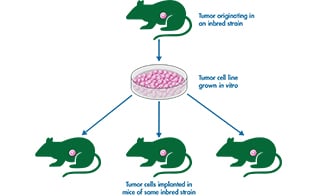
Move from T cell functional assays to T cell killing assays to in vivo syngeneic models within a single integrated platform.
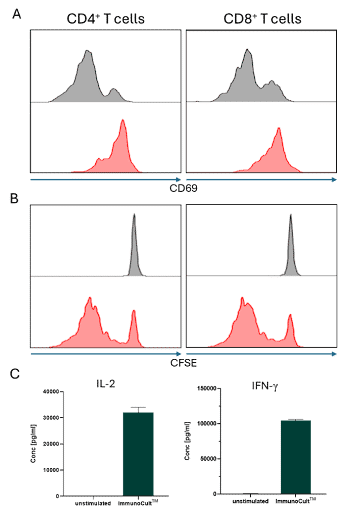
PBMCs from a healthy donor are labeled with CFSE and subsequently stimulated with ImmunoCult™. Surface markers (viability, CD3, CD4, CD8, CD69) are analyzed by flow cytometry after one and five days. Two days post‑stimulation, the supernatant is collected and assessed using a multiplex MSD electro-chemiluminescence ELISA.
Flow cytometric data demonstrate:
a) an upregulation of CD69 on CD4⁺ and CD8⁺ T cells (A, red),
b) decreased CFSE fluorescence, consistent with proliferative activity in both T‑cell subsets (B, red).
Furthermore, the stimulated T cells released IL‑2 and IFN‑γ into the medium (C).
T cells play a central role in cell-mediated immunity and can mediate long-term, antigen-specific, effector, and memory responses. Enhancing and engineering T cell responses to alter T cell functional capability has shown promise in the treatment of diseases like cancer and autoimmune diseases. The activation of naïve T cells by an antigen and costimulatory signals initiates clonal expansion of both CD4+ helper and CD8+ cytotoxic T cells. Engagement of the T cell antigen receptor (TCR)/CD3 complex and co-stimulatory receptor CD28 initiate intracellular signaling events and the activation of nuclear transcription factors such as the Nuclear Factor of Activated T cells (NFAT), NF-kB, and AP-1.
We employ engineered Jurkat T cells that stably express a luciferase reporter driven by an NFAT response element. When the TCR/CD3 effector cells (NFAT) are engaged with an appropriate TCR/CD3 ligand or anti-TCR/CD3 antibody, the TCR transduces intracellular signals, resulting in NFAT-RE-mediated luminescence. The bioluminescent signal is then detected and quantified using the Bio-Glo Luciferase assay system, which measures the potency of TCR constructs to activate T cells.
We have developed a systemic approach to T cell activation for drug discovery. T-cell activation can be checked by the expression of a luciferase reporter driven by either an NFAT response element or an IL-2 promoter. Both cell lines are available for assessing T cell activation by employing bioluminescent methods or ELISA kits.
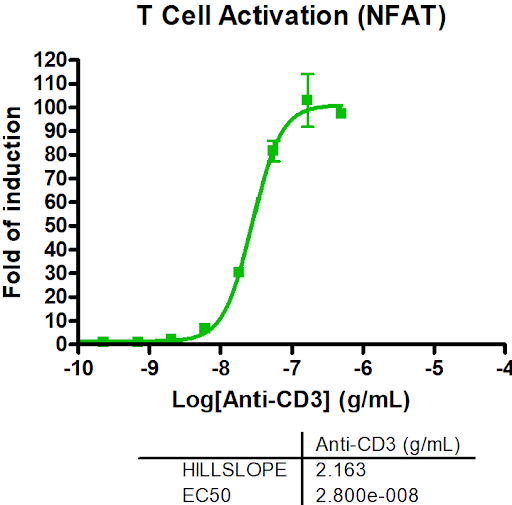
Representative data for the T cell activation bioassay.
T cell proliferation is one of the hallmarks of successfully activated T cells. Carboxyfluorescein succinimidyl ester (CFSE) is a cell-permeable dye that binds covalently to intracellular molecules and is retained within cells for very long periods. The intensity of CFSE in cells can be measured by flow cytometry. With each cell division, the intensity halves, enabling the identification of proliferating cells.
PBMCs are plated in multi-well plates coved with anti-CD3 antibodies, which engage the T cell receptor, triggering T cell activation and expansion. CFSE dye is used to track cell division by measuring CFSE intensity in the cells.
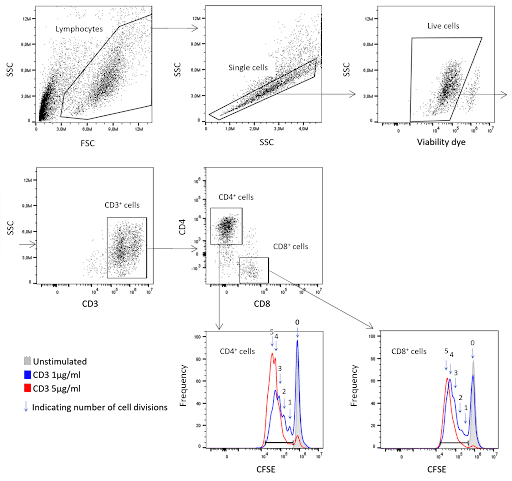
Healthy donor PMBCs were labeled with CFSE and either cultured in the presence of two different concentrations of plate-bound anti CD3 (OKT3) or left untreated. After 5 days, cells were harvested, stained with a fixable viability dye and surface markers (CD3, CD4, and CD8), and fixed with 4% PFA. Cells were acquired using a Cytoflex S (Beckman Coulter).
IL-2 is crucial for the generation, maintenance, and expansion of CD4+ regulatory T cells, as well as the cytotoxic activity of NK and CD8+ cells, and it also regulates homeostasis by eliminating harmful autoreactive T cells through activation-induced cell death. IL-2 signals via a receptor complex made up of CD25/IL-2R alpha, IL-2R beta, and the common gamma chain (Gamma C).
Multiple signaling pathways are activated when IL-2 binds to its receptors. Tyrosine kinases JAK1 and JAK3 are two important kinases recruited and activated at receptor cytoplasmic domains by the IL-2 signaling pathway. In turn, these kinases activate the STAT, PI3-AKT, and MAPK signaling pathways, which then mediates proliferation, survival, activation, and differentiation of a variety of immune cell types. IL-2 is approved for the treatment of patients with metastatic melanoma, renal cell carcinoma, and some patients with acute myelogenous leukemia have been successfully treated with high dose of IL-2 making IL-2 an important immunotherapeutic target.
To quantify IL-2 activation or inhibition
Genetically engineered IL-2 Bioassay cell lines were stimulated with recombinant human IL-2. After 6 hours of incubation, Bio-Glo Reagent was added, and luminescence was quantified using GloMax discover system.
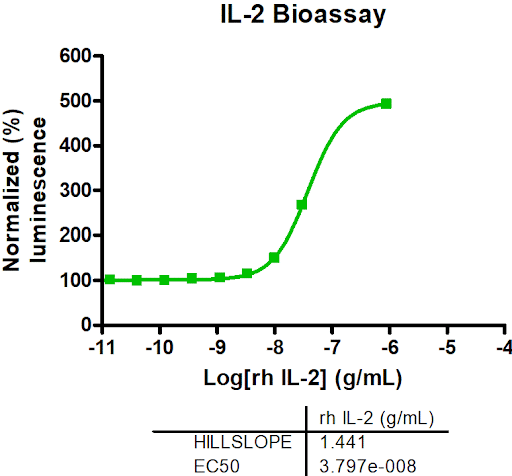
Measuring dose dependent IL-2 receptor mediated signaling when incubated with rh IL-2
T cell assays (this page) evaluate T cell function independent of tumor targets—measuring activation, proliferation, and cytokine responses. T cell killing assays specifically measure cytotoxic activity against tumor cells in co-culture. Both are often used together for comprehensive characterization.
We primarily use cryopreserved PBMCs or freshly isolated T cells from healthy human donors. Specific subsets (CD4+, CD8+, Tregs) can be purified as needed. We also accept customer-supplied cells.
Yes, our flow cytometry panels distinguish CD4+ helper T cells, CD8+ cytotoxic T cells, regulatory T cells (Tregs), and various memory/effector subsets. We can also purify specific populations for focused functional studies.
Standard stimulation uses anti-CD3/CD28 for polyclonal T cell activation. We also offer superantigen stimulation (SEB), mixed lymphocyte reaction, and antigen-specific stimulation using peptide-pulsed APCs.
Exhaustion is characterized by surface marker expression (elevated PD-1, TIM-3, LAG-3, CD39) combined with diminished functional capacity (reduced proliferation and cytokine production). We model exhaustion through repeated stimulation protocols.
Absolutely. T cell functional assays support therapeutic development in autoimmune disease, transplant immunology, infectious disease, and any indication where T cell modulation affects disease outcomes.
Whether profiling a checkpoint inhibitor, optimizing a co-stimulatory agonist, or characterizing responses to a novel modality, our team will design the right assay strategy.