K192 Kinome-Wide Panel
192 full-length kinases individually expressed and screened at a single concentration in duplicate, giving a broad primary read on selectivity across the kinome before hits move into dose-response follow-up.
Measure compound binding across our full kinase panel breadth in live cells
Quantify intracellular target engagement, selectivity, and residence time across 392 validated kinase targets, from single targets to our full 192-kinase K192 panel, using Promega NanoBRET technology.
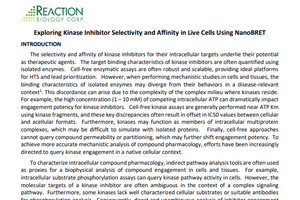
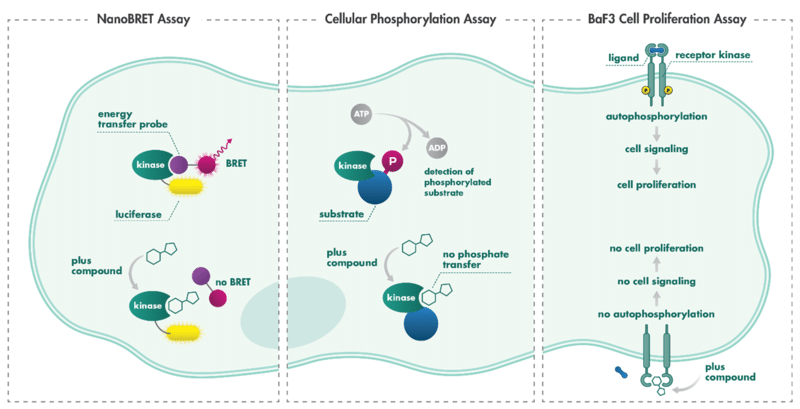
NanoBRET is a bioluminescence resonance energy transfer (BRET) assay that measures whether a compound engages its intended kinase target inside a living cell rather than in a test tube. The kinase of interest is expressed as a fusion with NanoLuc luciferase, and a cell-permeable fluorescent tracer reversibly occupies the same binding site, producing a baseline BRET signal that a test compound displaces in proportion to how much of the target it occupies.
Because the assay runs in intact cells, it captures what biochemical binding assays cannot: whether a compound crosses the plasma membrane, how it performs under physiological ATP and ion conditions, and how long it stays bound once inside. Reaction Biology runs NanoBRET across one of the broadest validated kinase panel libraries available, from single targets to full kinome-wide screening, so programs can move from early selectivity triage through focused resistance-mutation profiling on one platform.
How NanoBRET Works
192 full-length kinases individually expressed and screened at a single concentration in duplicate, giving a broad primary read on selectivity across the kinome before hits move into dose-response follow-up.
20 clinically relevant CDK-cyclin pairs run in 10-dose IC50 duplicate, purpose-built for assessing selectivity and residence time across the CDK family in around 4 weeks.
33 clinically relevant PIK3CA hotspot mutants paired with PIK3R1, resolving how resistance mutations shift compound potency relative to wild type.
14 MET variants including D1228, T1173I, and Y1230A resistance mutations, run alongside wild-type MET for direct potency comparison.
9 ABL1 variants including the T315I gatekeeper mutation, supporting resistance-profiling programs in CML and Ph+ ALL.
8 KIT variants spanning juxtamembrane and activation-loop mutations relevant to GIST and systemic mastocytosis programs.
7 FLT3 variants including D835 and ITD-relevant point mutations for AML-focused resistance profiling.
7 TEK variants for angiogenesis and vascular malformation research, including the A1124V and Y897 mutants.
6 conventional and novel PKC isoforms (alpha, beta, delta, epsilon, gamma, theta) in one panel for isoform-selectivity assessment.
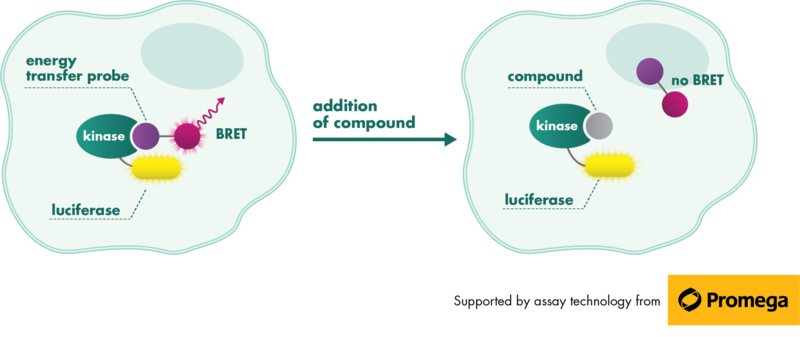
Test compound binding displaces the fluorescent tracer from the NanoLuc-kinase fusion, decreasing the BRET signal in proportion to target occupancy.
407 targets, each individually benchmarked with reference inhibitors before it reaches the catalog, so panel data is comparable across the full library rather than assembled from mixed validation standards.
Curated mutant panels (ABL1, FLT3, KIT, MET, PIK3CA) run in the same HEK293 background as their wild-type counterparts, isolating the potency shift attributable to the resistance mutation itself.
NanoBRET reports apparent intracellular affinity, fractional occupancy, and residence time from direct tracer displacement, rather than inferring engagement from a protein-stabilization proxy.
Targets outside the standard catalog can be built from a client-supplied probe or tracer submitted for evaluation, extending coverage beyond the fixed target list.
Results connect directly to our Cellular Phosphorylation Assay for activity confirmation and BaF3 Cell Proliferation Assay for functional readout, without switching platforms.
Screen up to 192 kinases at once at a single test concentration in duplicate, ideal for early selectivity triage before committing to full dose-response on confirmed hits.
Full dose-response binding curves in duplicate for single targets, the CDK panel, or any mutant family panel, delivering apparent affinity and fractional occupancy.
Wash out unbound compound and track tracer re-association over time to determine how long a compound stays bound to its target once inside the cell.
Submit a compound-specific tracer or probe for evaluation to extend testing to targets outside the standard 407-target catalog.
Assay principle: Measures compound binding to a NanoLuc-kinase fusion via competitive tracer displacement in intact cells.
Goal: Characterize inhibition of DDR1 by an ATP-competitive tyrosine kinase inhibitor.
Setup: HEK293 cells transiently expressing NanoLuc-DDR1 were seeded in 384-well plates and treated with Tracer K-4 and compound for 1 hour. BRET signal was read on an EnVision 2104 multilabel plate reader.

Assay principle: Measures how long a compound remains bound to its target after an unbound drug is washed out, using kinetic tracer re-association.
Goal: Compare residence time of dasatinib and ibrutinib on BTK.
Setup: HEK293 cells expressing BTK-NanoLuc were treated with DMSO, 250 nM dasatinib, or 1 uM ibrutinib for 2 hours, washed to remove unbound drug, then dosed with kinase tracer K10. NanoBRET was recorded kinetically on an EnVision 2104. Koff values were fit using a one-phase exponential association model in GraphPad Prism.

Assay principle: Demonstrates assay window and Z’-factor consistency across replicate runs.
Goal: Confirm reproducibility of the DDR1 NanoBRET assay at standard screening conditions.
Setup: 4,000 cells per well in 384-well format, 1-hour compound treatment, 0.0625 uM K4 tracer. DMSO served as negative control; a reference compound was run in every project alongside IC50 determination.

NanoBRET is a bioluminescence resonance energy transfer assay that measures compound binding to a kinase target inside live cells. A test compound competitively displaces a fluorescent tracer bound to a NanoLuc luciferase-kinase fusion, and the resulting signal loss is proportional to target occupancy.
407 validated kinase targets, each benchmarked with a reference inhibitor. Targets are available individually or across nine panels, including our 192-kinase K192 primary screening panel and focused mutant panels for ABL1, FLT3, KIT, MET, PIK3CA, PKC, and TEK.
K192 screens 192 kinases at a single concentration in duplicate, giving broad selectivity coverage across the kinome for early-stage triage. The focused mutant panels (ABL1, FLT3, KIT, MET, PIK3CA, TEK) run in 10-dose IC50 duplicate against a specific target family, suited for resistance-mutation profiling once a program has a defined target of interest.
Yes. Submit a compound-specific tracer or probe for evaluation and our team will assess feasibility for adding it to your project.
Residence time is how long a compound stays bound to its target after an unbound drug is removed. Two compounds with similar potency can have very different residence times, and longer residence time often correlates with more durable pharmacological effect in cells. Residence time analysis is available on request for any listed target.
Single targets and focused mutant panels typically report in 2 to 3 weeks; the CDK Panel (20 targets) and K192 Panel (192 targets) typically complete in around 4 weeks. Expedited scheduling is available on request. New or custom targets require approximately 2 weeks for assay establishment before compound testing begins.
Requests are triaged through our Malvern, PA, USA facility by default. Clients requiring EU-based execution can arrange technology transfer to our Freiburg, Germany site.
Typically 50 to 100 uL of a 10 to 50 mM DMSO stock, or 2 to 3 mg of solid material. See our FAQ page for full compound preparation and shipping guidance.
NanoBRET assays can be used to evaluate allosteric kinase inhibitors. However, assay sensitivity and suitability can vary depending on tracer selection and vector design. Because NanoBRET tracers are typically developed from Type I ATP‑competitive inhibitors, their responsiveness to non‑ATP‑site binders depends on whether allosteric binding induces a conformational change that decreases ATP‑site tracer affinity. Under those conditions, NanoBRET can effectively assess allosteric kinase inhibitors, including Type II, III, and IV inhibitors.
| Target | HGNC | Synonyms | Datasheet | Panels |
|---|---|---|---|---|
| AAK1 | AAK1 | AP2 associated kinase1 | IC50, K192 | K192 Kinome-Wide Panel |
| ABL1 | ABL1 | ABL; JTK7; P150; c-ABL; v-ABL | IC50 | ABL1 Mutant Panel |
| ABL1 (E255K) | ABL1 (E255K) | ABL; JTK7; P150; c-ABL; v-ABL | IC50 | ABL1 Mutant Panel |
| ABL1 (F317I) | ABL1 (F317I) | ABL; JTK7; P150; c-ABL; v-ABL | IC50 | ABL1 Mutant Panel |
| ABL1 (F317L) | ABL1 (F317L) | ABL; JTK7; P150; c-ABL; v-ABL | IC50 | ABL1 Mutant Panel |
| ABL1 (H396P) | ABL1 (H396P) | ABL; JTK7; P150; c-ABL; v-ABL | IC50 | ABL1 Mutant Panel |
| ABL1 (M351T) | ABL1 (M351T) | ABL; JTK7; P150; c-ABL; v-ABL | IC50 | ABL1 Mutant Panel |
| ABL1 (Q252H) | ABL1 (Q252H) | ABL; JTK7; P150; c-ABL; v-ABL | IC50 | ABL1 Mutant Panel |
| ABL1 (T315I) | ABL1 (T315I) | ABL; JTK7; P150; c-ABL; v-ABL | IC50 | ABL1 Mutant Panel |
| ABL1 (Y253F) | ABL1 (Y253F) | ABL; JTK7; P150; c-ABL; v-ABL | IC50 | ABL1 Mutant Panel |
| ABL2 | ABL2 | ABLL; ARG | IC50, K192 | K192 Kinome-Wide Panel |
| ACVR1 (G328V) | ACVR1 (G328V) | ACTRI, ACVRLK2, ALK2, SKR2 | IC50 | |
| ACVR1 (G356D) | ACVR1 (G356D) | ACTRI, ACVRLK2, ALK2, SKR3 | IC50 | |
| ACVR1 (Q207D) | ACVR1 (Q207D) | ACTRI, ACVRLK2, ALK2, SKR4 | IC50 | |
| ACVR1 (R206H) | ACVR1 (R206H) | ACTRI, ACVRLK2, ALK2, SKR6 | IC50 | |
| ADK | ADK | AK | IC50 | |
| AKT1 | AKT1 | PKB; RAC; PRKBA; RAc-ALPHA | IC50 | |
| AKT1 (E17K) | AKT1 (E17K) | PKB, RAC, PRKBA, RAc-ALPHA | IC50 | |
| AKT2 | AKT2 | PRKBB; PKBBETA; RAc-BETA | IC50, K192 | K192 Kinome-Wide Panel |
| AKT2 (E17K) | AKT2 (E17K) | PRKBB, PKBBETA, RAc-BETA | IC50 | |
| AKT3 (E17K) | AKT3 (E17K) | PKBG, PKB gamma, PRKBG, RAC-gamma, RAC-PK-gamma, STK-2 | IC50 | |
| AKT3 (G171R) | AKT3 (G171R) | PKBG, PKB gamma, PRKBG, RAC-gamma, RAC-PK-gamma, STK-2 | IC50 | |
| ALK1 | ACVRL1 | ACVRLK1; HHT; HHT2; ORW2; SKR3; ALK-1; ALK | IC50 | |
| ALK2 | ACVR1 | ACTRI; ACVRLK2; ALK2; SKR1 | IC50 | |
| ALK4 | ACVR1B | ACTRIB; ACVRLK4; SKR2; ALK4 | IC50 | |
| Aurora A | AURKA | AurA; AIK; ARK1; AURA; BTAK; STK15; AuroraA; Aurora A | IC50, K192 | K192 Kinome-Wide Panel |
| Aurora B | AURKB | AurB; AIK2; AIM1; ARK2; AurB; IPL1; STK5; AuroraB; Aurora B | IC50, K192 | K192 Kinome-Wide Panel |
| Aurora C | AURKC | AurC; AIE2; AIK3; STK13; Aurora C; AuroraC | IC50, K192 | K192 Kinome-Wide Panel |
| AXL | AXL | EC, UFO | IC50, K192 | K192 Kinome-Wide Panel |
| BLK | BLK | BLK | IC50 | |
| BMP2K | BMP2K | BMP2 inducible kinase, BIKe | IC50, K192 | K192 Kinome-Wide Panel |
| BMPR1A | BMPR1A | SKR5, CD292, ALK3, ACVRLK3 | IC50 | |
| BMX | BMX | ETK; PSCTK2; PSCTK3 | IC50, K192 | K192 Kinome-Wide Panel |
| BRAF (V600E) | BRAF (V600E) | B-Raf; BRAF1; RAFB1; B-raf-1 | IC50, K192 | K192 Kinome-Wide Panel |
| BRSK1 | BRSK1 | KIAA1811 | IC50, K192 | K192 Kinome-Wide Panel |
| BRSK2 | BRSK2 | C11orf7; PEN11B; SAD1; STK29; FLJ41362; HUSSY-12 | IC50, K192 | K192 Kinome-Wide Panel |
| BTK | BTK | AGMX1; AT; ATK; BPK; PSCTK1 | IC50, K192 | K192 Kinome-Wide Panel |
| BTK (C481S) | BTK (C481S) | AGMX1, AT, ATK, BPK, PSCTK1 | IC50 | |
| BTK (E41K) | BTK (E41K) | AGMX1, AT, ATK, BPK, PSCTK1 | IC50 | |
| BTK (P190K) | BTK (P190K) | AGMX1, AT, ATK, BPK, PSCTK1 | IC50 | |
| CAMK1 | CAMK1 | CAMK1-PEN, CAMKI | IC50, K192 | K192 Kinome-Wide Panel |
| CAMK1D | CAMK1D | CKLiK, CaM-K1, CaMKID | IC50 | |
| CAMK1G | CAMK1G | CLICKIII, VWS1, dJ272L16.1 | IC50 | |
| CAMK2A | CAMK2A | CAMKA, KIAA0968 | IC50, K192 | K192 Kinome-Wide Panel |
| CAMK2D | CAMK2D | CAMKD, MGC44911, CaMKII delta | IC50, K192 | K192 Kinome-Wide Panel |
| CAMK2G | CAMK2G | CAMK, CAMK-II, CAMKG, MGC26678 | IC50 | |
| CDK1+Cyclin B1 | CDK1-CCNB1 | CDC2; p34 | IC50, K192 | CDK Panel, K192 Kinome-Wide Panel |
| CDK1+Cyclin E1 | CDK1-CCNE1 | CDC2; p34 | IC50 | |
| CDK10+Cyclin L2 | CDK10-CCNL2 | PISSLRE | IC50, K192 | CDK Panel, K192 Kinome-Wide Panel |
| CDK11A+Cyclin K | CDK11A-CCNK | PITSLRE | IC50 | CDK Panel |
| CDK11A+Cyclin L2 | CDK11A-CCNL2 | PITSLRE | IC50 | |
| CDK12+Cyclin K | CDK12-CCNK | CRKRS; CRK7 | IC50 | CDK Panel |
| CDK13+Cyclin K | CDK13-CCNK | CDC2L; CDC2L5; CHED | IC50 | CDK Panel |
| CDK14+Cyclin Y | CDK14-CCNY | PFTK1; PFTAIRE1 | IC50, K192 | CDK Panel, K192 Kinome-Wide Panel |
| CDK15+Cyclin Y | CDK15-CCNY | ALS2CR7; PFTK2; PFTAIRE2 | IC50, K192 | CDK Panel, K192 Kinome-Wide Panel |
| CDK16+Cyclin Y | CDK16-CCNY | PCTAIRE; PCTGAIRE; PCTK1; PCTAIRE1 | IC50, K192 | CDK Panel, K192 Kinome-Wide Panel |
| CDK17+Cyclin Y | CDK17-CCNY | PCTK2; PCTAIRE2 | IC50, K192 | CDK Panel, K192 Kinome-Wide Panel |
| CDK18+Cyclin Y | CDK18-CCNY | PCTK3; PCTAIRE; PCTAIRE3 | IC50, K192 | CDK Panel, K192 Kinome-Wide Panel |
| CDK19+Cyclin C | CDK19-CCNC | CDC2L6, CDK11 | IC50 | CDK Panel |
| CDK2+Cyclin A1 | CDK2-CCNA1 | p33 | IC50 | |
| CDK2+Cyclin E1 | CDK2-CCNE1 | p33 | IC50, K192 | CDK Panel, K192 Kinome-Wide Panel |
| CDK20+Cyclin H | CDK20-CCNH | CAK-kinase p42; CCRK; CDCH; p42; PNQALRE | IC50, K192 | CDK Panel, K192 Kinome-Wide Panel |
| CDK3+Cyclin E1 | CDK3-CCNE1 | CDKN3 | IC50, K192 | CDK Panel, K192 Kinome-Wide Panel |
| CDK4+Cyclin D1 | CDK4-CCND1 | CMM3; PSK-J3 | IC50 | CDK Panel |
| CDK4+Cyclin D3 | CDK4-CCND3 | CMM3, PSK-J3 | IC50, K192 | K192 Kinome-Wide Panel |
| CDK5+CDK5R1 | CDK5-CDK5R1 | PSSALRE | IC50, K192 | CDK Panel, K192 Kinome-Wide Panel |
| CDK5+CDK5R2* | CDK5-CDK5R2 | PSSALRE | IC50 | |
| CDK6+Cyclin D1 | CDK6-CCND1 | PLSTIRE | IC50, K192 | CDK Panel, K192 Kinome-Wide Panel |
| CDK6+Cyclin D3 | CDK6-CCND3 | PLSTIRE | IC50 | |
| CDK7 | CDK7 | CAK1, CDKN7, STK1, p39MO15 | IC50, K192 | K192 Kinome-Wide Panel |
| CDK7+Cyclin H | CDK7-CCNH | CAK1; CDKN7; STK1; p39MO15 | IC50 | CDK Panel |
| CDK8+Cyclin C | CDK8-CCNC | K35 | IC50 | CDK Panel |
| CDK9+Cyclin K | CDK9-CCNK | C-2k, CDC2L4, PITALRE, TAK | IC50, K192 | CDK Panel, K192 Kinome-Wide Panel |
| CDK9+Cyclin T1 | CDK9-CCNT1 | C-2k; CDC2L4; PITALRE; TAK | IC50 | |
| CDK9+Cyclin T2 | CDK9-CCNT2 | C-2k; CDC2L4; PITALRE; TAK | IC50 | |
| CDKL1 | CDKL1 | KKIALRE | IC50, K192 | K192 Kinome-Wide Panel |
| CDKL2 | CDKL2 | KKIAMRE, P56 | IC50, K192 | K192 Kinome-Wide Panel |
| CDKL3 | CDKL3 | NKIAMRE | IC50, K192 | K192 Kinome-Wide Panel |
| CDKL5 | CDKL5 | CFAP247, EIEE2 | IC50, K192 | K192 Kinome-Wide Panel |
| CHEK1 | CHEK1 | CHK1 | IC50 | |
| CHEK2 | CHEK2 | CHK2; CDS1; HuCds1; PP1425; RAD53 | IC50, K192 | K192 Kinome-Wide Panel |
| CLK1 | CLK1 | CLK/STY; CLK | IC50, K192 | K192 Kinome-Wide Panel |
| CLK2 | CLK2 | MGC61500; hCLK2 | IC50, K192 | K192 Kinome-Wide Panel |
| CLK4 | CLK4 | DKFZp686A20267, CDc-like kinase 4 | IC50, K192 | K192 Kinome-Wide Panel |
| COQ8B | COQ8B | ADCK4 | IC50 | |
| CSF1R | CSF1R | FMS | IC50 | |
| CSK | CSK | CSK | IC50 | |
| CSNK1A1L | CSNK1A1L | CK1-alpha1 like, CK1a1L | IC50, K192 | K192 Kinome-Wide Panel |
| CSNK1D | CSNK1D | HCKID, CK1-delta, CK1d, CK1delta | IC50, K192 | K192 Kinome-Wide Panel |
| CSNK1E | CSNK1E | CKIe, HCKIE, MGC10398, CK1-epsilon | IC50 | |
| CSNK1G2 | CSNK1G2 | CK1g2, CK1-gamma2, CK1gamma2 | IC50, K192 | K192 Kinome-Wide Panel |
| CSNK2A1 | CSNK2A1 | CKII, CK2A1, CK2-alpha1, CK2alpha1, CK2a | IC50, K192 | K192 Kinome-Wide Panel |
| CSNK2A2 | CSNK2A2 | CK2a2 | IC50, K192 | K192 Kinome-Wide Panel |
| DAPK2 | DAPK2 | DRP-1 | IC50, K192 | K192 Kinome-Wide Panel |
| DCLK3 | DCLK3 | DCAMKL3, DCDC3C | IC50, K192 | K192 Kinome-Wide Panel |
| DDR1 | DDR1 | CAK; CD167; EDDR1; MCK10; NEP; DDR | IC50 | |
| DDR2 | DDR2 | MIG20a; NTRKR3; TKT; TYRO10 | IC50 | |
| DDR2 (N456S) | DDR2 (N456S) | MIG20a, NTRKR3, TKT, TYRO10 | IC50 | |
| DYRK1A | DYRK1A | DYRK; DYRK1; HP86; MNB; MNBH | IC50, K192 | K192 Kinome-Wide Panel |
| DYRK1B | DYRK1B | MIRK | IC50, K192 | K192 Kinome-Wide Panel |
| DYRK2 | DYRK2 | DYRK2 | IC50 | |
| DYRK3 | DYRK3 | DYRK5, RED, REDK | IC50 | |
| EIF2AK4 | EIF2AK4 | GCN2 | IC50 | |
| EPHA1 | EPHA1 | EPH; EPHT; EPHT1 | IC50, K192 | K192 Kinome-Wide Panel |
| EPHA2 | EPHA2 | ECK | IC50 | |
| EPHA3 | EPHA3 | ETK, ETK1, HEKECK, HEK4, TYRO4 | IC50 | |
| EPHA4 | EPHA4 | HEK8; SEK; TYRO1 | IC50, K192 | K192 Kinome-Wide Panel |
| EPHA5 | EPHA5 | CEK7; EHK1; HEK7 | IC50 | |
| EPHA6 | EPHA6 | EHK2, EHK-2, EPA6 | IC50, K192 | K192 Kinome-Wide Panel |
| EPHA7 | EPHA7 | EHK3, HEK11 | IC50, K192 | K192 Kinome-Wide Panel |
| EPHA8 | EPHA8 | EEK; HEK3; KIAA1459 | IC50 | |
| EPHB1 | EPHB1 | ELK, NET, Hek6, EPHT2 | IC50, K192 | K192 Kinome-Wide Panel |
| EPHB2 | EPHB2 | DRT; ERK; Hek5; EPHT3; Tyro5 | IC50 | |
| EPHB3 | EPHB3 | ETK2; HEK2; TYRO6 | IC50 | |
| EPHB4 | EPHB4 | HTK; MYK1; TYRO11 | IC50, K192 | K192 Kinome-Wide Panel |
| ERK1 | MAPK3 | ERT2, HS44KDAP, HUMKER1A, P44ERK1, P44MAPK, PRKM3 | IC50 | |
| ERN1 | ERN1 | IRE1 | IC50, K192 | K192 Kinome-Wide Panel |
| ERN2 | ERN2 | IRE2 | IC50, K192 | K192 Kinome-Wide Panel |
| FER | FER | TYK3, c-FER, p94-FER | IC50, K192 | K192 Kinome-Wide Panel |
| FES | FES | FPS | IC50, K192 | K192 Kinome-Wide Panel |
| FGFR1 | FGFR1 | H2; H3; H4; H5; CEK; FLG; FLT2; KAL2; BFGFR; C-FGR; N-SAM | IC50, K192 | K192 Kinome-Wide Panel |
| FGFR2 | FGFR2 | BEK; JWS; CEK3; CFD1; ECT1; KGFR; | IC50, K192 | K192 Kinome-Wide Panel |
| FGFR3 | FGFR3 | ACH, CD333, CEK2, HSFGFR3EX, JTK4 | IC50, K192 | K192 Kinome-Wide Panel |
| FGFR3 (G697C) | FGFR3 (G697C) | ACH, CD333, CEK2, HSFGFR3EX, JTK4 | IC50 | |
| FGFR4 | FGFR4 | TKF; JTK2; MGC20292 | IC50, K192 | K192 Kinome-Wide Panel |
| FGR | FGR | SRC2; c-fgr; p55c-fgr | IC50 | |
| FLT1 | FLT1 | FLT, VEGFR1, FLT1, VEGF-R1 | IC50 | |
| FLT3 | FLT3 | FLK2; STK1; CD135 | IC50, K192 | K192 Kinome-Wide Panel, FLT3 Mutant Panel |
| FLT3 (D835H) | FLT3 (D835H) | FLK2; STK1; CD135 | IC50 | FLT3 Mutant Panel |
| FLT3 (D835V) | FLT3 (D835V) | FLK2; STK1; CD135 | IC50 | FLT3 Mutant Panel |
| FLT3 (D835Y) | FLT3 (D835Y) | FLK2; STK1; CD135 | IC50 | FLT3 Mutant Panel |
| FLT3 (K663Q) | FLT3 (K663Q) | FLK2; STK1; CD135 | IC50 | FLT3 Mutant Panel |
| FLT3 (N841I) | FLT3 (N841I) | FLK2; STK1; CD135 | IC50 | FLT3 Mutant Panel |
| FLT3 (R834Q) | FLT3 (R834Q) | FLK2; STK1; CD135 | IC50 | FLT3 Mutant Panel |
| FRK | FRK | PTK5, GTK, RAK | IC50 | |
| FYN | FYN | SLK, SYN, p59-Fyn | IC50, K192 | K192 Kinome-Wide Panel |
| FYN (Y531F) | FYN (Y531F) | SLK, SYN, p59-FYN | IC50 | |
| GAK | GAK | DNAJC26 | IC50, K192 | K192 Kinome-Wide Panel |
| GSK3A | GSK3A | GSK3-alpha, GSK3a | IC50 | |
| GSK3B | GSK3B | GSK3-beta, GSK3b | IC50 | |
| HCK | HCK | JTK9 | IC50 | |
| HIPK2 | HIPK2 | PRO0593 | IC50, K192 | K192 Kinome-Wide Panel |
| HIPK3 | HIPK3 | ANPK, DYRK6, FIST, FIST3, PKY, YAK1 | IC50, K192 | K192 Kinome-Wide Panel |
| HIPK4 | HIPK4 | FLJ32818 | IC50, K192 | K192 Kinome-Wide Panel |
| HUNK | HUNK | HUNK | IC50 | |
| ICK | CILK1 | LCK2, ICK, MRK | IC50, K192 | K192 Kinome-Wide Panel |
| IGF1R | IGF1R | JTK13, IGFR, CD221 | IC50, K192 | K192 Kinome-Wide Panel |
| IKBKE | IKBKE | IKKI; IKK-i; KIAA0151; IKK-epsilon; IKKepsilon | IC50, K192 | K192 Kinome-Wide Panel |
| INSR | INSR | IR | IC50, K192 | K192 Kinome-Wide Panel |
| IRAK1 | IRAK1 | Pelle | IC50 | |
| IRAK3 | IRAK3 | IRAK-M | IC50, K192 | K192 Kinome-Wide Panel |
| IRAK4 | IRAK4 | NY-REN-64 | IC50, K192 | K192 Kinome-Wide Panel |
| ITK | ITK | EMT 2; LYK 2; PSCTK2 2 | IC50, K192 | K192 Kinome-Wide Panel |
| JAK2 | JAK2 | JAK2 | IC50 | |
| JAK2 (JH1 domain) | JAK2 (JH1) | JAK2 | IC50 | |
| JAK2 (V617F) | JAK2 (V617F) | JAK2 | IC50, K192 | K192 Kinome-Wide Panel |
| JAK3 | JAK3 | JAKL; L-JAK; LJAK | IC50, K192 | K192 Kinome-Wide Panel |
| JNK1 (MAPK8) | MAPK8 | JNK1-alpha1, PRKM8, SAPK1 | IC50, K192 | K192 Kinome-Wide Panel |
| JNK3 | MAPK10 | JNK3A; PRKM10; p493F12 | IC50, K192 | K192 Kinome-Wide Panel |
| KIT | KIT | PBT; CD117; SCFR; c-KIT | IC50 | KIT Mutant Panel |
| KIT (A829P) | KIT (A829P) | C-Kit, PBT, CD117, SCFR | IC50 | KIT Mutant Panel |
| KIT (D816H) | KIT (D816H) | PBT; CD117; SCFR; c-KIT | IC50 | KIT Mutant Panel |
| KIT (D816V) | KIT (D816V) | C-Kit, PBT, CD117, SCFR | IC50 | KIT Mutant Panel |
| KIT (L576P) | KIT (L576P) | PBT; CD117; SCFR; c-KIT | IC50 | KIT Mutant Panel |
| KIT (V559D) | KIT (V559D) | PBT; CD117; SCFR; c-KIT | IC50 | KIT Mutant Panel |
| KIT (V559D,T670I) | KIT (V559D/T670I) | C-Kit, PBT, CD117, SCFR | IC50 | KIT Mutant Panel |
| KIT (V559D,V654A) | KIT (V559D/V654A) | C-Kit, PBT, CD117, SCFR | IC50 | KIT Mutant Panel |
| LATS1 | LATS1 | WARTS; wts | IC50, K192 | K192 Kinome-Wide Panel |
| LATS2 | LATS2 | FLJ13161, LATS | IC50, K192 | K192 Kinome-Wide Panel |
| LCK | LCK | LCK | IC50, K192 | K192 Kinome-Wide Panel |
| LIMK1 | LIMK1 | LIMK1 | IC50, K192 | K192 Kinome-Wide Panel |
| LIMK2 | LIMK2 | LIMK2 | IC50, K192 | K192 Kinome-Wide Panel |
| LRRK2 | LRRK2 | PARK8; ROCO2; FLJ45829 | IC50, K192 | K192 Kinome-Wide Panel |
| LRRK2 (G2019S) | LRRK2 (G2019S) | PARK8, ROCO2, FLJ45829, DKFZp434H2112 | IC50 | |
| LRRK2 (I2020T) | LRRK2 (I2020T) | PARK8, ROCO2, FLJ45829, DKFZp434H2114 | IC50 | |
| LRRK2 (R1441C) | LRRK2 (R1441C) | PARK8, ROCO2, FLJ45829, DKFZp434H2116 | IC50 | |
| LTK | LTK | TYK1 | IC50, K192 | K192 Kinome-Wide Panel |
| LYN | LYN | LYNB | IC50 | |
| MAP2K1/KRAS(G12C) | MAP2K1/KRAS(G12C) | MEK1, MAPKK1, MKK1, PRKMK1 | IC50 | |
| MAP2K2/KRAS(G12C) | MAP2K2/KRAS(G12C) | MEK2, MAPKK2, MKK2, PRKMK2 | IC50 | |
| MAP2K6 | MAP2K6 | MAPKK6, MEK6, PRKMK6, SAPKK3 | IC50 | |
| MAP3K10 | MAP3K10 | MLK2; MST; MEKK10 | IC50, K192 | K192 Kinome-Wide Panel |
| MAP3K11 | MAP3K11 | MGC17114, MLK-3, PTK1, SPRK, MLK3 | IC50, K192 | K192 Kinome-Wide Panel |
| MAP3K12 | MAP3K12 | DLK | IC50, K192 | K192 Kinome-Wide Panel |
| MAP3K13 | MAP3K13 | LZK, MEKK13 | IC50 | |
| MAP3K19 | MAP3K19 | M3K19, RCK, YSK4 | IC50, K192 | K192 Kinome-Wide Panel |
| MAP3K2 | MAP3K2 | MAPKKK2, MEKK2B, MEKK2 | IC50, K192 | K192 Kinome-Wide Panel |
| MAP3K21 | MAP3K21 | KIAA1804 | IC50, K192 | K192 Kinome-Wide Panel |
| MAP3K3 | MAP3K3 | MAPKKK3, MEK kinase3, MEKK3 | IC50, K192 | K192 Kinome-Wide Panel |
| MAP3K4 | MAP3K4 | MAPKKK4, MEKK 4, MEKK4, MTK1, PRO0412 | IC50, K192 | K192 Kinome-Wide Panel |
| MAP4K1 | MAP4K1 | HPK1 | IC50, K192 | K192 Kinome-Wide Panel |
| MAP4K2 | MAP4K2 | BL44; GCK; RAB8IP | IC50, K192 | K192 Kinome-Wide Panel |
| MAP4K3 | MAP4K3 | GLK | IC50, K192 | K192 Kinome-Wide Panel |
| MAP4K5 | MAP4K5 | KHS1, GCKR, KHS, MAPKKKK5 | IC50, K192 | K192 Kinome-Wide Panel |
| MAPK1 | MAPK1 | ERK2; ERT1; P42MAPK; PRKM1 | IC50 | |
| MAPK1/KRAS(G12C) | MAPK1/KRAS(G12C) | ERK2; ERT1; P42MAPK; PRKM1 | IC50 | |
| MAPK11 | MAPK11 | p38-beta; P38BETA2; PRKM11; SAPK2 | IC50, K192 | K192 Kinome-Wide Panel |
| MAPK14 | MAPK14 | p38-alpha, CSBP, CSBP1, p38alpha, p38a | IC50, K192 | K192 Kinome-Wide Panel |
| MAPK14 (T106M) | MAPK14 (T106M) | p38-alpha, CSBP, CSBP1, p38alpha, p38a | IC50 | |
| MAPK3/KRAS(G12C) | MAPK3/KRAS(G12C) | ERT2, HS44KDAP, HUMKER1A, P44ERK1, P44MAPK, PRKM3 | IC50 | |
| MAPK4 | MAPK4 | PRKM4; Erk3-relatedErk4 | IC50, K192 | K192 Kinome-Wide Panel |
| MAPK6 | MAPK6 | PRKM6; ERK3p97MAPKHsT17250 | IC50, K192 | K192 Kinome-Wide Panel |
| MAPK9 | MAPK9 | JNK2; JNK2A; JNK2ALPHA; JNK2B; PRKM9; SAPK | IC50, K192 | K192 Kinome-Wide Panel |
| MARK2 | MARK2 | EMK1, MGC99619, PAR-1Ba, ELKL | IC50, K192 | K192 Kinome-Wide Panel |
| MARK3 | MARK3 | CTAK1, KP78, PAR1A | IC50 | |
| MARK4 | MARK4 | KIAA1860; MARKL1 | IC50, K192 | K192 Kinome-Wide Panel |
| MAST3 | MAST3 | Microtubule-associated serine/threonine-protein kinase 3, KIAA0561 | IC50, K192 | K192 Kinome-Wide Panel |
| MAST4 | MAST4 | KIAA0303 | IC50, K192 | K192 Kinome-Wide Panel |
| MELK | MELK | KIAA0175; PK38 | IC50, K192 | K192 Kinome-Wide Panel |
| MELK (T460M) | MELK (T460M) | KIAA0175, PK38 | IC50 | |
| MERTK | MERTK | MER, MER-PEN, RP38, c-Mer | IC50, K192 | K192 Kinome-Wide Panel |
| MERTK (A708S)* | MERTK (A708S) | MER, MER-PEN, RP38, c-Mer | IC50 | |
| MET | MET | c-MET; HGFR; RCCP2 | IC50, K192 | K192 Kinome-Wide Panel, MET Mutant Panel |
| MET (D1228H) | MET (D1228H) | c-MET, HGFR, RCCP2 | IC50 | MET Mutant Panel |
| MET (D1228N) | MET (D1228N) | c-MET, HGFR, RCCP2 | IC50 | MET Mutant Panel |
| MET (F1200I) | MET (F1200I) | c-MET, HGFR, RCCP2 | IC50 | MET Mutant Panel |
| MET (M1250T) | MET (M1250T) | c-MET; HGFR; RCCP2 | IC50 | MET Mutant Panel |
| MET (P991S) | MET (P991S) | c-MET, HGFR, RCCP2 | IC50 | MET Mutant Panel |
| MET (T1173I) | MET (T1173I) | c-MET, HGFR, RCCP2 | IC50 | MET Mutant Panel |
| MET (T992I) | MET (T992I) | c-MET, HGFR, RCCP2 | IC50 | MET Mutant Panel |
| MET (V1092I) | MET (V1092I) | c-MET, HGFR, RCCP2 | IC50 | MET Mutant Panel |
| MET (Y1230A) | MET (Y1230A) | c-MET, HGFR, RCCP2 | IC50 | MET Mutant Panel |
| MET (Y1230C) | MET (Y1230C) | c-MET, HGFR, RCCP2 | IC50 | MET Mutant Panel |
| MET (Y1230D) | MET (Y1230D) | c-MET, HGFR, RCCP2 | IC50 | MET Mutant Panel |
| MET (Y1230H) | MET (Y1230H) | c-MET, HGFR, RCCP2 | IC50 | MET Mutant Panel |
| MET (Y1235D) | MET (Y1235D) | c-MET; HGFR; RCCP2 | IC50 | MET Mutant Panel |
| MKNK2 | MKNK2 | MNK2 | IC50, K192 | K192 Kinome-Wide Panel |
| MLK1 | MAP3K9 | MLK1, PRKE1, MEKK9 | IC50, K192 | K192 Kinome-Wide Panel |
| MLTK | MAP3K20 | MLTK, mlklak, ZAK | IC50, K192 | K192 Kinome-Wide Panel |
| MOK | MOK | RAGE | IC50 | |
| MUSK | MUSK | MUSK | IC50, K192 | K192 Kinome-Wide Panel |
| MYLK2 | MYLK2 | KMLC; skMLCK; MLCK2 | IC50, K192 | K192 Kinome-Wide Panel |
| MYLK3 | MYLK3 | caMLCK, MLCK | IC50, K192 | K192 Kinome-Wide Panel |
| MYLK4 | MYLK4 | Myosin light chain kinase family member 4 | IC50, K192 | K192 Kinome-Wide Panel |
| NEK1 | NEK1 | KIAA1901; NY-REN-55 | IC50, K192 | K192 Kinome-Wide Panel |
| NEK11 | NEK11 | FLJ23495 | IC50, K192 | K192 Kinome-Wide Panel |
| NEK2 | NEK2 | NLK1; HsPK21; HsPK 21 | IC50, K192 | K192 Kinome-Wide Panel |
| NEK3 | NEK3 | HSPK36; MGC29949 | IC50, K192 | K192 Kinome-Wide Panel |
| NEK4 | NEK4 | NRK2; STK2 | IC50, K192 | K192 Kinome-Wide Panel |
| NEK5 | NEK5 | MGC75495 | IC50, K192 | K192 Kinome-Wide Panel |
| NEK6 | NEK6 | SID6-1512 | IC50 | |
| NEK9 | NEK9 | DKFZp434D0935; MGC16714; NERCC | IC50, K192 | K192 Kinome-Wide Panel |
| NIM1K | NIM1K | NIM1 | IC50, K192 | K192 Kinome-Wide Panel |
| NLK | NLK | NLK | IC50, K192 | K192 Kinome-Wide Panel |
| NRK | NRK | NESK | IC50 | |
| NTRK1 (G667C) | NTRK1 (G667C) | MTC, TRK, TRK2 | IC50 | |
| NUAK1 | NUAK1 | ARK5; KIAA0537 | IC50, K192 | K192 Kinome-Wide Panel |
| NUAK2 | NUAK2 | SNARK, DKFZp434J037 | IC50 | |
| PAK4 | PAK4 | p21(CDKN1A)-activated kinase 4 | IC50, K192 | K192 Kinome-Wide Panel |
| PAK6 | PAK6 | PAK6, PAK5 | IC50, K192 | K192 Kinome-Wide Panel |
| PAK7 | PAK5 | PAK7, PAK5, KIAA1264, MGC26232 | IC50 | |
| PDGFRA (V561D) | PDGFRA (V561D) | PDGFRalpha, PDGFR2, CD140a | IC50 | |
| PHKG1 | PHKG1 | phosphorylase kinase catalytic subunit gamma 1 | IC50, K192 | K192 Kinome-Wide Panel |
| PHKG2* | PHKG2 | PHKg2 | IC50, K192 | K192 Kinome-Wide Panel |
| PIK3C3 | PIK3C3 | MGC61518, PI3-kinase type 3, PI3K type 3, Vps34 | IC50 | |
| PIK3CA (C420R)/PIK3R1 | PIK3CA (C420R)-PIK3R1 | MGC142161, MGC142163, p110-alpha, PI3K, PI3K-alpha | IC50 | PIK3CA Mutant Panel |
| PIK3CA (E542K)/PIK3R1 | PIK3CA (E542K)-PIK3R1 | MGC142161, MGC142163, p110-alpha, PI3K, PI3K-alpha | IC50 | PIK3CA Mutant Panel |
| PIK3CA (E545A)/PIK3R1 | PIK3CA (E545A)-PIK3R1 | MGC142161, MGC142163, p110-alpha, PI3K, PI3K-alpha | IC50 | PIK3CA Mutant Panel |
| PIK3CA (E545K)/PIK3R1 | PIK3CA (E545K)-PIK3R1 | MGC142161, MGC142163, p110-alpha, PI3K, PI3K-alpha | IC50 | PIK3CA Mutant Panel |
| PIK3CA (H1047L)/PIK3R1 | PIK3CA (H1047L)-PIK3R1 | MGC142161, MGC142163, p110-alpha, PI3K, PI3K-alpha | IC50 | PIK3CA Mutant Panel |
| PIK3CA (H1047R)/PIK3R1 | PIK3CA (H1047R)-PIK3R1 | MGC142161, MGC142163, p110-alpha, PI3K, PI3K-alpha | IC50 | PIK3CA Mutant Panel |
| PIK3CA (H1047Y)/PIK3R1 | PIK3CA (H1047Y)-PIK3R1 | MGC142161, MGC142163, p110-alpha, PI3K, PI3K-alpha | IC50 | PIK3CA Mutant Panel |
| PIK3CA (I800L)/PIK3R1 | PIK3CA (I800L)-PIK3R1 | MGC142161, MGC142163, p110-alpha, PI3K, PI3K-alpha | IC50 | PIK3CA Mutant Panel |
| PIK3CA (M1043I)/PIK3R1 | PIK3CA (M1043I)-PIK3R1 | MGC142161, MGC142163, p110-alpha, PI3K, PI3K-alpha | IC50 | PIK3CA Mutant Panel |
| PIK3CA (Q546K)/PIK3R1 | PIK3CA (Q546K)-PIK3R1 | MGC142161, MGC142163, p110-alpha, PI3K, PI3K-alpha | IC50 | PIK3CA Mutant Panel |
| PIK3CA/PIK3R1 | PIK3CA-PIK3R1 | MGC142161, MGC142163, p110-alpha, PI3K, PI3K-alpha | IC50 | PIK3CA Mutant Panel |
| PIK3CB/PIK3R1 | PIK3CB-PIK3R1 | PI3K, PI3KBETA, PIK3C1, p110-beta | IC50 | |
| PIK3CD/PIK3R1 | PIK3CD-PIK3R1 | p110D, P110DELTA, PI3K, PI3K-delta, p110-delta | IC50 | |
| PIKFYVE | PIKFYVE | MGC40423, PIP5K, PIP5K3, ZFYVE29, FAB1, KIAA0981 | IC50 | |
| PIM3 | PIM3 | PIM3 | IC50 | |
| PIP4K2C | PIP4K2C | PIP5K2C, FLJ22055 | IC50 | |
| PIP5K1B | PIP5K1B | MSS4, STM7 | IC50 | |
| PKMYT1 | PKMYT1 | MYT1 | IC50, K192 | K192 Kinome-Wide Panel |
| PKN3 | PKN3 | PRK3, PKNbeta, RP11-545E17.1 | IC50 | |
| PLK1 | PLK1 | STPK13 | IC50 | |
| PLK2 | PLK2 | SNK | IC50, K192 | K192 Kinome-Wide Panel |
| PLK3 | PLK3 | CNK, FNK, PRK | IC50, K192 | K192 Kinome-Wide Panel |
| PLK4 | PLK4 | SAK; STK18 | IC50, K192 | K192 Kinome-Wide Panel |
| PRKAA1 | PRKAA1 | AMPK, AMPKa1 | IC50, K192 | K192 Kinome-Wide Panel |
| PRKAA2 | PRKAA2 | AMPK; AMPKa2 | IC50, K192 | K192 Kinome-Wide Panel |
| PRKACA | PRKACA | PKA; PKACa | IC50, K192 | K192 Kinome-Wide Panel |
| PRKACB | PRKACB | PKAcb, MGC41879, MGC9320, PKA c-beta | IC50, K192 | K192 Kinome-Wide Panel |
| PRKCE (epsilon) | PRKCE | PKCE, nPKC-epsilon, PKC-epsilon | IC50, K192 | K192 Kinome-Wide Panel, PKC Panel |
| PRKG2 | PRKG2 | PKG2, cGKII, PRKGR2 | IC50 | |
| PRKX | PRKX | PKX1 | IC50, K192 | K192 Kinome-Wide Panel |
| PTK2 | PTK2 | FAK; FADK | IC50, K192 | K192 Kinome-Wide Panel |
| PTK6 | PTK6 | BRK | IC50, K192 | K192 Kinome-Wide Panel |
| PYK2 | PTK2B | CADTK, CAKB, FADK2, FAK2, PKB, PTK, RAFTK, CAK beta | IC50, K192 | K192 Kinome-Wide Panel |
| RET | RET | PTC; MTC1; HSCR1; MEN2A; MEN2B; CDHF12; CDHR16; RET51 | IC50, K192 | K192 Kinome-Wide Panel |
| RET (M918T) | RET (M918T) | CDHF12, CDHR16, HSCR1, MEN2A, MEN2B, MTC1, PTC, RET51 | IC50 | |
| RET (V804L) | RET (V804L) | CDHF12, CDHR16, HSCR1, MEN2A, MEN2B, MTC1, PTC, RET51 | IC50 | |
| RET (V804M) | RET (V804M) | CDHF12, CDHR16, HSCR1, MEN2A, MEN2B, MTC1, PTC, RET51 | IC50 | |
| RIOK2 | RIOK2 | FLJ11159 | IC50, K192 | K192 Kinome-Wide Panel |
| RIPK1 | RIPK1 | RIP | IC50, K192 | K192 Kinome-Wide Panel |
| RIPK2 | RIPK2 | RICK; RIP2; CARDIAK; CARD3; CCK; GIG30; RIP-2 | IC50, K192 | K192 Kinome-Wide Panel |
| ROCK1 | ROCK1 | P160ROCK | IC50 | |
| ROCK2 | ROCK2 | KIAA0619, ROC2 | IC50 | |
| RON | MST1R | CD136; CDw136; PTK8; RON | IC50, K192 | K192 Kinome-Wide Panel |
| RPS6KA1 | RPS6KA1 | RSK1, HU-1, MAPKAPK1, p90Rsk | IC50, K192 | K192 Kinome-Wide Panel |
| RPS6KA2 | RPS6KA2 | RSK3, HU-2 | IC50, K192 | K192 Kinome-Wide Panel |
| RPS6KA3 | RPS6KA3 | RSK2, HU-3, MRX19, CLS | IC50, K192 | K192 Kinome-Wide Panel |
| RPS6KA3 (I416V) | RPS6KA3 (I416V) | RSK2, HU-3, MRX19, CLS | IC50 | |
| RPS6KA3 (L608F) | RPS6KA3 (L608F) | RSK2, HU-3, MRX19, CLS | IC50 | |
| RPS6KA4 | RPS6KA4 | MSK2; RSK-B | IC50, K192 | K192 Kinome-Wide Panel |
| RPS6KA6 | RPS6KA6 | RSK4 | IC50, K192 | K192 Kinome-Wide Panel |
| SBK3 | SBK3 | SGK110 | IC50, K192 | K192 Kinome-Wide Panel |
| SGK1 | SGK1 | SGK | IC50, K192 | K192 Kinome-Wide Panel |
| SGK2 | SGK2 | H-SGK2, dJ138B7.2 | IC50 | |
| SIK1 | SIK1 | MSK; SNF1LK; SIK | IC50, K192 | K192 Kinome-Wide Panel |
| SIK2 | SIK2 | SIK2 | IC50, K192 | K192 Kinome-Wide Panel |
| SIK3 | SIK3 | SIK3 | IC50, K192 | K192 Kinome-Wide Panel |
| SLK | SLK | KIAA0204, STK2 | IC50, K192 | K192 Kinome-Wide Panel |
| SNRK | SNRK | SNF1-related kinase | IC50, K192 | K192 Kinome-Wide Panel |
| SRC | SRC | c-SRC; ASV; p60-SRC; SRC1 | IC50 | |
| SRMS | SRMS | C20orf148, SRM, dJ697K14.1 | IC50, K192 | K192 Kinome-Wide Panel |
| STK10 | STK10 | PRO2729; LOK | IC50, K192 | K192 Kinome-Wide Panel |
| STK11 | STK11 | LKB1 | IC50, K192 | K192 Kinome-Wide Panel |
| STK16 | STK16 | PKL12; MPSK; TSF1 | IC50, K192 | K192 Kinome-Wide Panel |
| STK17B | STK17B | DRAK2 | IC50, K192 | K192 Kinome-Wide Panel |
| STK24 | STK24 | MST3 | IC50 | |
| STK26 | STK26 | MASK, MST4 | IC50 | |
| STK3 | STK3 | KRS1, MST2 | IC50, K192 | K192 Kinome-Wide Panel |
| STK32A | STK32A | YANK1 | IC50 | |
| STK32B | STK32B | YANK2 | IC50, K192 | K192 Kinome-Wide Panel |
| STK33 | STK33 | STK33 | IC50, K192 | K192 Kinome-Wide Panel |
| STK35 | STK35 | CLIK1, STK35L1 | IC50, K192 | K192 Kinome-Wide Panel |
| STK36 | STK36 | FU | IC50, K192 | K192 Kinome-Wide Panel |
| STK38 | STK38 | NDR1 | IC50, K192 | K192 Kinome-Wide Panel |
| STK38L | STK38L | NDR2, KIAA0965 | IC50, K192 | K192 Kinome-Wide Panel |
| STK4 | STK4 | KRS2, MST1, YSK3 | IC50, K192 | K192 Kinome-Wide Panel |
| TBK1 | TBK1 | CDC37; HSPCA; HSPCB; IKBKG; NAK; T2K | IC50, K192 | K192 Kinome-Wide Panel |
| TEC | TEC | PSCTK4 | IC50, K192 | K192 Kinome-Wide Panel |
| TEK | TEK | VMCM; TIE-2; VMCM1; CD202B | IC50, K192 | K192 Kinome-Wide Panel, TEK Mutant Panel |
| TEK (A1124V) | TEK (A1124V) | CD202B, TIE-2, TIE2, VMCM, VMCM1 | IC50 | TEK Mutant Panel |
| TEK (P883A) | TEK (P883A) | CD202B, TIE-2, TIE2, VMCM, VMCM1 | IC50 | TEK Mutant Panel |
| TEK (R849W) | TEK (R849W) | CD202B, TIE-2, TIE2, VMCM, VMCM1 | IC50 | TEK Mutant Panel |
| TEK (Y1108F) | TEK (Y1108F) | CD202B, TIE-2, TIE2, VMCM, VMCM1 | IC50 | TEK Mutant Panel |
| TEK (Y897C) | TEK (Y897C) | CD202B, TIE-2, TIE2, VMCM, VMCM1 | IC50 | TEK Mutant Panel |
| TEK (Y897S) | TEK (Y897S) | CD202B, TIE-2, TIE2, VMCM, VMCM1 | IC50 | TEK Mutant Panel |
| TESK1 | TESK1 | TESK1 | IC50 | |
| TGFBR2 | TGFBR2 | MFS2, RIIC, TBR-ii, TBRII, TGFR-2, TGFbeta-RII, HNPCC6 | IC50 | |
| TIE1 | TIE1 | JTK14, TIE | IC50, K192 | K192 Kinome-Wide Panel |
| TLK1 | TLK1 | PKU-beta, KIAA0137 | IC50, K192 | K192 Kinome-Wide Panel |
| TLK2 | TLK2 | MGC44450; PKU-ALPHA | IC50, K192 | K192 Kinome-Wide Panel |
| TNK1 | TNK1 | TNK1 | IC50, K192 | K192 Kinome-Wide Panel |
| TNK2 | TNK2 | ACK, p21cdc42Hs, Activated CDC42 kinase 1, ACK1 | IC50, K192 | K192 Kinome-Wide Panel |
| TNNI3K | TNNI3K | CARK, CCDD | IC50, K192 | K192 Kinome-Wide Panel |
| TRKA | NTRK1 | MTC, TRK, TRK1 | IC50, K192 | K192 Kinome-Wide Panel |
| TRKB | NTRK2 | TRKB | IC50, K192 | K192 Kinome-Wide Panel |
| TSSK1B* | TSSK1B | TSSK1, FKSG81, SPOGA4, STK22D | IC50 | |
| TTK | TTK | PYT, MPS1, ESK, MPS1L1 | IC50 | |
| TXK | TXK | BTKL, PSCTK5, PTK4, RLK | IC50, K192 | K192 Kinome-Wide Panel |
| TYK2 | TYK2 | JTK1 | IC50 | |
| TYK2 (JH1 domain) | TYK2 (JH1) | JTK1 | IC50 | |
| TYK2 (JH2 domain) | TYK2 (JH2) | JTK1 | IC50 | |
| TYRO3 | TYRO3 | BYK, Brt, Dtk, Sky, Tif | IC50, K192 | K192 Kinome-Wide Panel |
| ULK1 | ULK1 | UNC51; Unc51.1 | IC50, K192 | K192 Kinome-Wide Panel |
| ULK2 | ULK2 | ATG1B, KIAA0623, Unc51.2 | IC50, K192 | K192 Kinome-Wide Panel |
| ULK3 | ULK3 | FLJ90566, DKFZP434C131 | IC50, K192 | K192 Kinome-Wide Panel |
| WEE1 | WEE1 | WEE1hu | IC50, K192 | K192 Kinome-Wide Panel |
| WEE2 | WEE2 | FLJ16107, WEE1B | IC50, K192 | K192 Kinome-Wide Panel |
| YES1 | YES1 | YES; HsT441; P61-YES; C-YES, YES1 | IC50 | |
| ROS1(1883-2347) | ROS1 | ROS, MCF3 | IC50 | |
| EGFR (L858R, T790M) | EGFR (L858R, T790M) | EGFR | IC50 | |
| PIK3CA (D549N)/PIK3R1 | PIK3CA (D549N)-PIK3R1 | MGC142161, MGC142163, p110-alpha, PI3K, PI3K-alpha | IC50 | PIK3CA Mutant Panel |
| PIK3CA (D725G)/PIK3R1 | PIK3CA (D725G)-PIK3R1 | MGC142161, MGC142163, p110-alpha, PI3K, PI3K-alpha | IC50 | PIK3CA Mutant Panel |
| PIK3CA (E172Q)/PIK3R1 | PIK3CA (E172Q)-PIK3R1 | MGC142161, MGC142163, p110-alpha, PI3K, PI3K-alpha | IC50 | PIK3CA Mutant Panel |
| PIK3CA (E418K)/PIK3R1 | PIK3CA (E418K)-PIK3R1 | MGC142161, MGC142163, p110-alpha, PI3K, PI3K-alpha | IC50 | PIK3CA Mutant Panel |
| PIK3CA (E545K/D549N)/PIK3R1 | PIK3CA (E545K/D549N)-PIK3R1 | MGC142161, MGC142163, p110-alpha, PI3K, PI3K-alpha | IC50 | PIK3CA Mutant Panel |
| PIK3CA (E545K/D725G)/PIK3R1 | PIK3CA (E545K/D725G)-PIK3R1 | MGC142161, MGC142163, p110-alpha, PI3K, PI3K-alpha | IC50 | PIK3CA Mutant Panel |
| PIK3CA (E545K/E418K)/PIK3R1 | PIK3CA (E545K/E418K)-PIK3R1 | MGC142161, MGC142163, p110-alpha, PI3K, PI3K-alpha | IC50 | PIK3CA Mutant Panel |
| PIK3CA (E545K/E453K)/PIK3R1 | PIK3CA (E545K/E453K)-PIK3R1 | MGC142161, MGC142163, p110-alpha, PI3K, PI3K-alpha | IC50 | PIK3CA Mutant Panel |
| PIK3CA (E545K/I197K)/PIK3R1 | PIK3CA (E545K/I197K)-PIK3R1 | MGC142161, MGC142163, p110-alpha, PI3K, PI3K-alpha | IC50 | PIK3CA Mutant Panel |
| PIK3CA (E545K/S576C)/PIK3R1 | PIK3CA (E545K/S576C)-PIK3R1 | MGC142161, MGC142163, p110-alpha, PI3K, PI3K-alpha | IC50 | PIK3CA Mutant Panel |
| PIK3CA (H1047R/M1004I)/PIK3R1 | PIK3CA (H1047R/M1004I)-PIK3R1 | MGC142161, MGC142163, p110-alpha, PI3K, PI3K-alpha | IC50 | PIK3CA Mutant Panel |
| PIK3CA (H1047R/Q859H)/PIK3R1 | PIK3CA (H1047R/Q859H)-PIK3R1 | MGC142161, MGC142163, p110-alpha, PI3K, PI3K-alpha | IC50 | PIK3CA Mutant Panel |
| PIK3CA (H1047R/Q859K)/PIK3R1 | PIK3CA (H1047R/Q859K)-PIK3R1 | MGC142161, MGC142163, p110-alpha, PI3K, PI3K-alpha | IC50 | PIK3CA Mutant Panel |
| PIK3CA (H1047R/R88Q)/PIK3R1 | PIK3CA (H1047R/R88Q)-PIK3R1 | MGC142161, MGC142163, p110-alpha, PI3K, PI3K-alpha | IC50 | PIK3CA Mutant Panel |
| PIK3CA (H1047R/W780R)/PIK3R1 | PIK3CA (H1047R/W780R)-PIK3R1 | MGC142161, MGC142163, p110-alpha, PI3K, PI3K-alpha | IC50 | PIK3CA Mutant Panel |
| PIK3CA (I197K)/PIK3R1 | PIK3CA (I197K)-PIK3R1 | MGC142161, MGC142163, p110-alpha, PI3K, PI3K-alpha | IC50 | PIK3CA Mutant Panel |
| PIK3CA (M1004I)/PIK3R1 | PIK3CA (M1004I)-PIK3R1 | MGC142161, MGC142163, p110-alpha, PI3K, PI3K-alpha | IC50 | PIK3CA Mutant Panel |
| PIK3CA (Q859H)/PIK3R1 | PIK3CA (Q859H)-PIK3R1 | MGC142161, MGC142163, p110-alpha, PI3K, PI3K-alpha | IC50 | PIK3CA Mutant Panel |
| PIK3CA (Q859K)/PIK3R1 | PIK3CA (Q859K)-PIK3R1 | MGC142161, MGC142163, p110-alpha, PI3K, PI3K-alpha | IC50 | PIK3CA Mutant Panel |
| PIK3CA (R88Q)/PIK3R1 | PIK3CA (R88Q)-PIK3R1 | MGC142161, MGC142163, p110-alpha, PI3K, PI3K-alpha | IC50 | PIK3CA Mutant Panel |
| PIK3CA (S576C)/PIK3R1 | PIK3CA (S576C)-PIK3R1 | MGC142161, MGC142163, p110-alpha, PI3K, PI3K-alpha | IC50 | PIK3CA Mutant Panel |
| PIK3CA (W780R)/PIK3R1 | PIK3CA (W780R)-PIK3R1 | MGC142161, MGC142163, p110-alpha, PI3K, PI3K-alpha | IC50 | PIK3CA Mutant Panel |
| PRKCA (alpha) | PRKCA | PRKACA, PKC-alpha, PKCa, PKCalpha | IC50 | PKC Panel |
| PRKCB (beta) | PRKCB | PRKCB1, PKCB, PRKCB2, MGC41878, PKC-beta, PKC-beta1 | IC50 | PKC Panel |
| PRKCD (delta) | PRKCD | MAY1, MGC49908, nPKC-delta, PKC-delta | IC50 | PKC Panel |
| PRKCG (gamma) | PRKCG | PKCC, PKCG, SCA14, MGC57564, PKC-gamma | IC50 | PKC Panel |
| PRKCQ (theta) | PRKCQ | PRKCT, nPKC-theta | IC50 | PKC Panel |
| PIM1 | PIM1 | PIM | IC50 | |
| BTK (T474I) | BTK | AGMX1, AT, ATK, BPK, PSCTK1 | IC50 | |
| BTK (L528W) | BTK | AGMX1, AT, ATK, BPK, PSCTK1 | IC50 | |
| CAMKK2(165-445) | CAMKK2 | CAMKK, CAMKKB, KIAA0787, MGC15254 | IC50 | |
| EIF2AK2(252-551) | EIF2AK2 | EIF2AK1, PKR, PRKR, EIF2AK2, PKR | IC50 | |
| FGFR2 (K659M) | FGFR2 | BEK, BFR-1, CD332, CEK3, CFD1, ECT1, JWS, KGFR, KSAM, K-SAM, TK14, TK25 | IC50 | |
| FGFR2 (M537I) | FGFR2 | BEK, BFR-1, CD332, CEK3, CFD1, ECT1, JWS, KGFR, KSAM, K-SAM, TK14, TK25 | IC50 | |
| FGFR2 (N549H) | FGFR2 | BEK, BFR-1, CD332, CEK3, CFD1, ECT1, JWS, KGFR, KSAM, K-SAM, TK14, TK25 | IC50 | |
| FGFR3 (K650E) | FGFR3 | ACH, CD333, CEK2, HSFGFR3EX, JTK4 | IC50 | |
| FGFR2 (L617F) | FGFR2 | BEK, BFR-1, CD332, CEK3, CFD1, ECT1, JWS, KGFR, KSAM, K-SAM, TK14, TK25 | IC50 | |
| FGFR2 (L617V) | FGFR2 | BEK, BFR-1, CD332, CEK3, CFD1, ECT1, JWS, KGFR, KSAM, K-SAM, TK14, TK25 | IC50 | |
| FGFR3 (L608V) | FGFR3 | ACH, CD333, CEK2, HSFGFR3EX, JTK4 | IC50 | |
| FGFR3 (V553M) | FGFR3 | ACH, CD333, CEK2, HSFGFR3EX, JTK4 | IC50 | |
| FGFR3 (V555F) | FGFR3 | ACH, CD333, CEK2, HSFGFR3EX, JTK4 | IC50 | |
| FGFR3 (V555M) | FGFR3 | ACH, CD333, CEK2, HSFGFR3EX, JTK4 | IC50 | |
| FGFR3 (G380R) | FGFR3 | ACH, CD333, CEK2, HSFGFR3EX, JTK4 | IC50 |
* Please allow 2 weeks for final assay establishment at the Reaction Biology screening facility before the client compound testing begins.
* Please contact us for a residence time analysis study on any of the above-mentioned targets.